On this page
The U.S. Department of the Treasury recently concluded its AI Innovation Series, emphasizing that AI governance is now essential to the future of financial services. Bringing together regulators, financial institutions, and technology leaders, the discussions focused on balancing AI innovation with trust, resilience, and regulatory oversight. The initiative reinforces a growing industry consensus: as AI adoption accelerates, strong governance frameworks must evolve alongside it to ensure responsible, secure, and compliant deployment.
According to Gartner, only 13% of organizations say they have the appropriate governance structures in place to manage AI effectively, despite rapid adoption across the enterprise.
For the past two years, the AI conversation has been dominated by technology. Organizations have raced to adopt the latest models, experiment with new tools, and invest heavily in AI-powered solutions. Yet many of these same organizations are discovering that deploying AI is much easier than turning it into lasting business value. The issue is not the technology itself; most companies already have access to powerful AI capabilities. The real challenge lies in managing AI consistently across the enterprise. Without clear oversight, departments often adopt AI independently, creating fragmented processes, inconsistent standards, and growing compliance risks. This is where TeamSync comes in.
TeamSync helps organizations bring structure, visibility, and accountability to their AI initiatives, ensuring that innovation happens within a framework of governance and control. By providing a unified approach to AI oversight, TeamSync enables businesses to scale adoption confidently, manage risks proactively, and transform AI from a collection of isolated tools into a coordinated enterprise capability. In an era where AI is becoming embedded in every business function, governance is what separates experimentation from transformation, and TeamSync helps organizations bridge that gap.
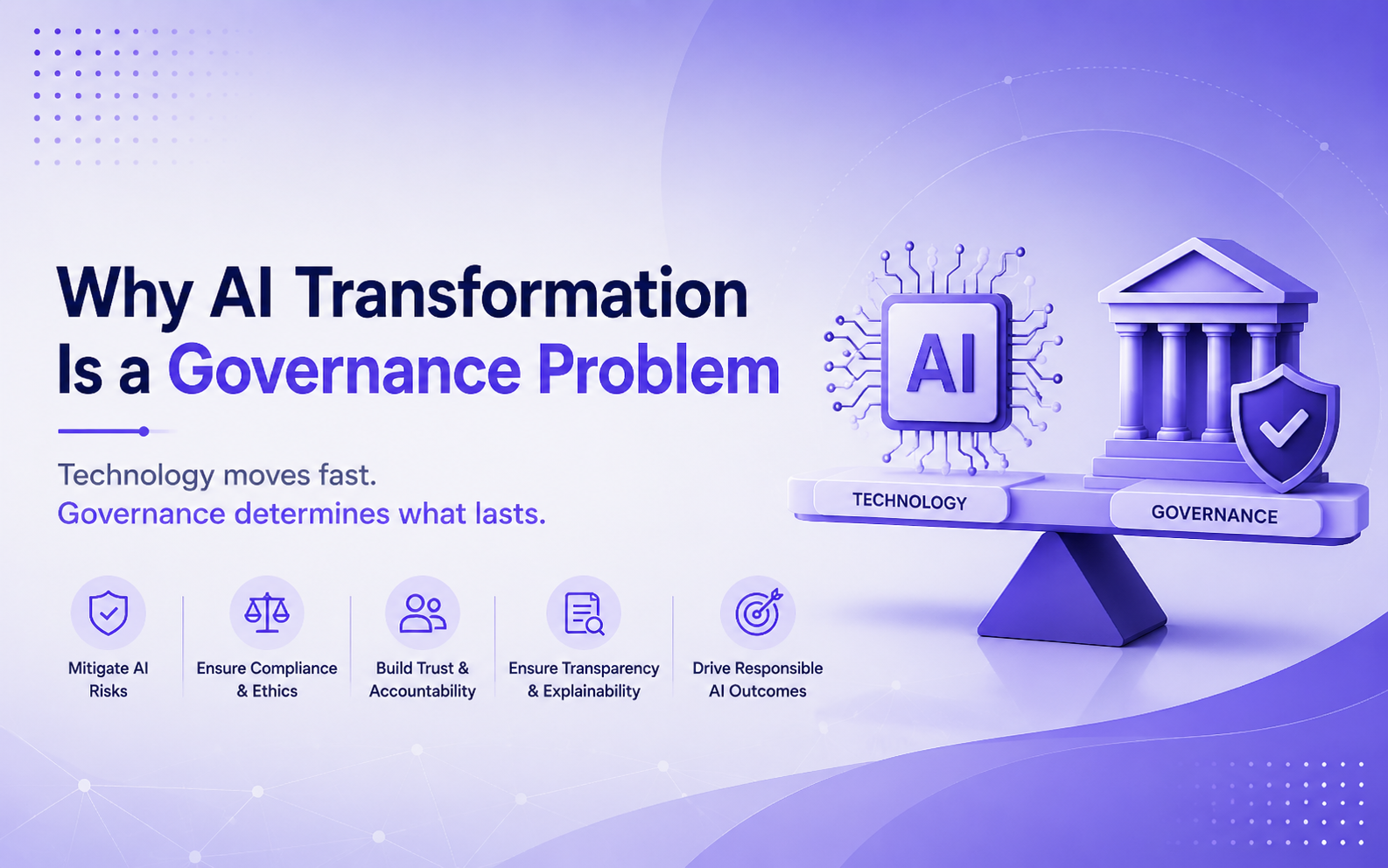
Why AI Transformation Is a Governance Problem
Many organizations think AI transformation is mainly about technology. In reality, success depends on having the right governance structures in place. Strong AI enterprise governance, AI operational governance, and AI business-specific governance help organizations manage AI effectively and achieve long-term results.
1. AI Requires Clear Decision-Making and Accountability
AI projects need clear ownership. Organizations must define who is responsible for AI strategy, implementation, and oversight. AI enterprise governance helps establish accountability, so AI initiatives stay aligned with business goals and deliver measurable outcomes.
2. AI Introduces New Risks That Must Be Managed
AI can create risks related to privacy, security, bias, and compliance. Without proper controls, these risks can impact business operations and reputation. AI operational governance provides the processes needed to monitor and reduce these risks.
3. Consistent Standards Are Essential for Scale
Different teams often adopt AI in different ways, leading to inconsistent practices. AI enterprise governance creates common policies and standards across the organization. This makes it easier to scale AI initiatives efficiently and responsibly.
4. Trust and Compliance Depend on Governance
Customers, employees, and regulators want assurance that AI is being used responsibly. AI business-specific governance helps teams follow industry regulations and ethical guidelines. This builds trust while supporting compliance requirements.
5. Technology Alone Does Not Drive Transformation
Buying AI tools is easy, but achieving real business value is much harder. Organizations need ongoing oversight, performance monitoring, and continuous improvement. AI operational governance ensures AI systems remain effective and aligned with business objectives.
The AI Adoption Problem Nobody Expected
When generative AI first entered the enterprise, many leaders assumed technology would be the primary challenge. The focus was on selecting the right tools, integrating them into existing systems, and training employees to use them effectively. The assumption was that once those pieces were in place, transformation would naturally follow. But that's not what happened.
Instead, organizations discovered that AI adoption creates a new category of operational complexity.
A marketing team starts using AI to create content. Sales teams begin relying on AI assistants for prospect research. HR departments experiment with AI-powered recruitment tools. Legal teams use generative AI for contracts management. Individually, each initiative makes sense.
Collectively, they create a governance challenge. Suddenly, AI is influencing decisions across multiple departments, interacting with sensitive business data, and shaping customer experiences. Yet in many organizations, there is no consistent framework governing how these systems are used. The result is a fragmented environment where AI adoption grows faster than organizational oversight.
That imbalance is where transformation efforts begin to break down.
Why Governance Matters More Than Technology
1. Governance Enables Safe and Responsible AI Use
Technology provides AI capabilities, but governance ensures those capabilities are used ethically, securely, and in compliance with regulations. Clear policies help manage risks and prevent misuse.
2. Governance Creates Consistency Across the Organization
Without governance, different teams may develop their own AI practices, leading to fragmented processes and inconsistent outcomes. A governance framework establishes common standards and best practices.
3. Governance Establishes Accountability
Effective AI deployment requires clear ownership of decisions, data management, and risk oversight. Governance defines roles and responsibilities, ensuring accountability when issues arise.
4. Governance Supports Scalable AI Adoption
Organizations can only expand AI successfully when there are structured processes for monitoring, evaluation, and continuous improvement. Governance transforms AI from isolated experiments into a sustainable enterprise capability.
Why AI Business-Specific Governance Is Becoming Critical
A common mistake organizations make is believing that one AI policy can work for every department. In reality, different business functions use AI in different ways and face different risks. For example, HR teams using AI for hiring must focus on fairness, privacy, and reducing bias. Finance teams need strong controls for compliance, auditing, and decision tracking, while legal departments must protect confidential and privileged information. Because each department operates under unique regulations and responsibilities, a single generic AI policy often creates confusion and gaps in oversight. Business-specific governance solves this problem by tailoring AI rules, controls, and accountability measures to the needs of each function, allowing organizations to innovate responsibly while managing risks effectively.
The Governance Gap Is the Next Enterprise Challenge
Today, most conversations about AI focus on what the technology can do. Every few months, new AI models are introduced, new tools enter the market, and businesses are excited about the latest innovations. While these advancements are impressive, many organizations are discovering that the real challenge is not the technology itself.
The bigger question is whether an organization can manage AI effectively as its use grows. It's relatively easy to experiment with AI in a few teams, but scaling it across an entire business requires strong AI enterprise governance, clear accountability, risk management, and oversight. Without these foundations, organizations often face inconsistent results, compliance concerns, and confusion about how AI should be used.
Companies that invest in AI enterprise governance and AI operational governance will be better positioned to adopt AI with confidence, meet regulatory requirements, and build trust with employees, customers, and stakeholders. These governance frameworks help organizations establish consistent standards while ensuring AI initiatives remain aligned with business objectives.
In contrast, organizations that overlook governance may struggle to move beyond isolated AI projects and achieve lasting business value. As AI becomes a core part of business operations, success will depend not only on having the best technology but also on having the maturity and discipline to govern it effectively. The governance gap is likely to be one of the most important enterprise challenges in the years ahead.
Where TeamSync Fits Into the Picture
Many organizations have already invested in AI. The challenge now is not finding more AI tools; it is ensuring those tools are being used effectively, responsibly, and in alignment with business objectives.
As AI spreads across departments, leaders often lose visibility into how it is being used, what risks are emerging, and whether teams are following established policies. This can lead to compliance gaps, inconsistent practices, and increased operational risk. Without effective AI operational governance, organizations may struggle to monitor AI usage and maintain control as adoption expands.
TeamSync addresses this challenge by bringing structure to AI adoption. It acts as a governance framework that supports AI enterprise governance by helping organizations move from scattered AI experimentation to coordinated, enterprise-wide AI management. By providing visibility, accountability, and standardized oversight, TeamSync enables businesses to understand where AI is being used, assess associated risks, and maintain compliance without disrupting innovation.
The platform also supports AI business-specific governance, allowing individual departments and teams to align AI usage with their unique operational requirements while remaining consistent with enterprise-wide policies. This helps organizations balance flexibility with control.
In a business environment where AI is becoming a core operational capability, the organizations that succeed will be those that can balance innovation with control. TeamSync helps bridge that gap through stronger AI enterprise governance, effective AI operational governance, and practical AI business-specific governance, ensuring that AI delivers value not just quickly, but sustainably and responsibly.