On this page
- Healthcare compliance means following the rules that protect patients, data, and public funds
- Healthcare Compliance vs. Patient Adherence: What's the Difference?
- Why Healthcare Compliance Matters?
- Key Healthcare Compliance Laws You Need to Know
- How Healthcare Compliance Works Across Teams
- Examples of compliance in healthcare you can actually picture
- The 7 Essential Elements of an Effective Healthcare Compliance Program
- How TeamSync Helps Healthcare Organizations Navigate Compliance with Confidence
- 1. HIPAA (Privacy & Security Rules)
- 2. HITECH Act
- 3. False Claims Act (FCA)
- 4. Anti-Kickback Statute (AKS) & Stark Law
- 5. OSHA Healthcare Standards
- 6. CMS Documentation & Billing Requirements
- What happens when healthcare organizations miss the mark
- Streamline Compliance with Connected Workflows
- Map your compliance workflow before the next audit forces the issue
Healthcare compliance is one of those things most organizations only notice when something goes wrong. A data breach, a failed audit, a billing investigation, or a regulator asking questions can suddenly turn policies that were sitting untouched into the center of attention.
In healthcare, compliance failures rarely stay quiet. HHS says OCR received 732 notifications of large breaches that occurred in 2023, and OCR later said more than 167 million people were affected by large breaches that year, a new record. The same pressure shows up on the money side: the Department of Justice reported on January 15, 2025, that False Claims Act settlements and judgments topped $2.9 billion in fiscal year 2024, with more than $1.67 billion tied to healthcare matters. Meanwhile, the HHS Office of Inspector General’s General Compliance Program Guidance frames an effective compliance program as part of preventing fraud, waste, and abuse. Patient safety, privacy, trust, and organizational integrity are all on the line at once. For U.S. health systems and large practices, that is the real backdrop for compliance work. The breach numbers come from OCR’s 2023 breach reporting and its 2024 HIPAA Security Rule proposal.
What we've noticed at TeamSync is that the biggest challenge usually isn't that organizations don't care about compliance. It's that the work is scattered. Policies live in one folder, Business Associate Agreements (BAAs) sit in email inboxes, training records stay with HR, access reviews happen in IT, and incident notes disappear into ticketing systems. Everyone is doing their part, but no one has a complete picture.
That's why effective healthcare compliance isn't just about having the right policies. It's about connecting the people, processes, and documentation so compliance becomes part of everyday operations instead of something teams scramble to prove before an audit.
Healthcare compliance means following the rules that protect patients, data, and public funds
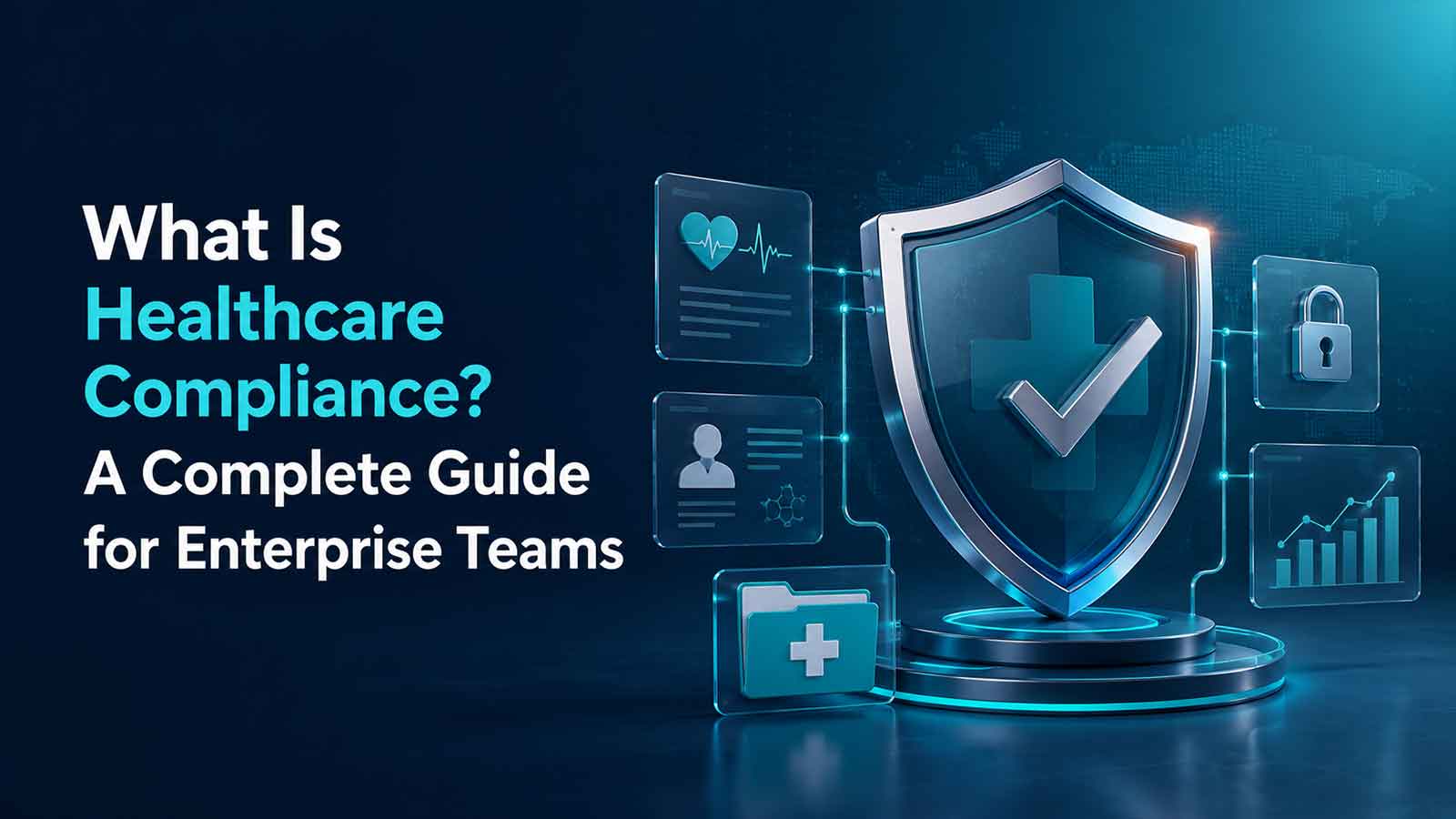
If you are asking what compliance in healthcare is, the short answer is this: it is the work of making sure a healthcare organization follows applicable laws, regulations, and ethical standards. Another way to answer what healthcare compliance is to think of it as the operating system behind safe care and honest reimbursement. Our practical healthcare compliance definition is broader than “don’t break the law.” It includes policies, internal controls, training, monitoring, and oversight that help teams follow healthcare laws, payer rules, and internal standards across billing, documentation, privacy, security, quality of care, and workplace safety.
That matters because the narrow legal definition only tells you what the rules are. The operational definition tells you how teams live with them. In real organizations, compliance shows up in access permissions, clinical note quality, claim edits, exclusion checks, retention schedules, vendor contracts, staff training, and incident response. Corporate compliance in healthcare is the enterprise-wide function that keeps leadership, managers, staff, and business associates aligned with external requirements and internal expectations. It is ongoing by design because the risks keep moving.
Healthcare Compliance vs. Patient Adherence: What's the Difference?
The word compliance has two very different meanings in healthcare, and confusing them can lead to misunderstandings. One refers to how healthcare organizations follow laws and regulations, while the other refers to how patients follow medical advice. Although both use the same word, they address completely different responsibilities.
Healthcare compliance (also called regulatory or organizational compliance) is about ensuring that healthcare providers, hospitals, health systems, insurance plans, and healthcare vendors operate within applicable laws, regulations, and industry standards. This includes protecting patient health information, maintaining accurate clinical documentation, preventing fraud and abuse, following billing requirements, managing vendor relationships, and creating internal policies that support ethical and lawful operations. It is an organization-wide effort involving leadership, clinicians, IT, HR, billing teams, compliance officers, and business associates.
Patient compliance, on the other hand, describes whether a patient follows a prescribed treatment plan. This could mean taking medications as directed, attending follow-up appointments, following dietary recommendations, or completing physical therapy exercises. In recent years, many healthcare professionals have shifted from using the term patient compliance to patient adherence because it emphasizes collaboration between patients and clinicians rather than implying that patients should simply obey medical instructions.
The distinction matters because the challenges, goals, and stakeholders are entirely different. Organizational compliance focuses on reducing legal, financial, operational, and reputational risk while ensuring safe, ethical care delivery. Patient adherence focuses on improving individual health outcomes by encouraging patients to actively participate in their care plans.
Because both meanings are widely used, people searching for "compliance in healthcare" often mean different things. Some are looking for information about medication adherence or patient behavior, while others want to understand regulations like HIPAA, the False Claims Act, or healthcare compliance programs.
Why Healthcare Compliance Matters?
The importance of compliance in healthcare starts with patients. Privacy rules protect deeply personal information. Security rules help keep appointments, labs, medication lists, and care plans available when clinicians need them. Billing and documentation rules are not abstract either. They shape whether the record supports medical necessity and whether care decisions are traceable when something goes wrong. OSHA standards matter here too because worker safety problems spill into patient safety problems in a hurry.
If a board member asks why compliance is important in healthcare, the financial answer is easy to see. False claims exposure, kickback risk, Stark issues, HIPAA penalties, corrective action plans, payer recoupments, and outside monitoring all cost real money. The OIG’s physician fraud and abuse overview also makes clear that some violations can lead to exclusion from federal healthcare programs. For a hospital, health system, or multi-site practice, exclusion from Medicare or Medicaid is not just a legal problem. It is an existential one.
Trust is the third reason, and it is harder to rebuild than money. One privacy mistake can pull in legal, IT, revenue cycle, frontline staff, compliance leadership, and outside vendors at the same time. Patients notice. Payers notice. Regulators notice. So do recruiting candidates and board members. In healthcare, compliance is part of how an organization proves it can be trusted with care, data, and public funds.
Key Healthcare Compliance Laws You Need to Know
HIPAA (Privacy & Security Rules)
HIPAA is the foundation of healthcare compliance in the U.S. It protects patient health information (PHI) by regulating how it is accessed, shared, and stored, while requiring organizations to implement strong security measures for electronic health records.HITECH Act
The HITECH Act strengthens HIPAA by requiring organizations to notify patients and regulators after certain data breaches. It also promotes the secure adoption and use of electronic health records (EHRs).False Claims Act (FCA)
The FCA prohibits submitting false or fraudulent claims to government healthcare programs like Medicare and Medicaid. Violations can lead to significant financial penalties, legal action, and reputational damage.Anti-Kickback Statute (AKS)
This law makes it illegal to offer or accept payments, gifts, or other incentives in exchange for patient referrals involving federal healthcare programs. Its goal is to prevent fraud and ensure medical decisions are based on patient needs.Stark Law
The Stark Law restricts physicians from referring patients to healthcare entities where they have a financial interest. It helps reduce conflicts of interest and unnecessary medical services.OSHA Healthcare Standards
OSHA regulations protect healthcare workers by setting requirements for workplace safety, infection control, employee training, and exposure prevention. Compliance helps create a safer environment for both staff and patients.CMS Documentation & Billing Requirements
CMS requires accurate clinical documentation to support billing claims and demonstrate medical necessity. Proper documentation reduces audit risks, claim denials, and compliance violations.
How Healthcare Compliance Works Across Teams
A physician practice owner approves the budget, signs vendor agreements, assigns an owner for privacy and security tasks, and decides whether the organization will actually follow through on risk assessments and policy updates. A hospital administrator translates that into training schedules, audit calendars, committee review, and escalation paths. A nurse manager lives in the details: access to charts, documentation standards, texting habits, downtime procedures, and quick escalation when something feels off.
Billing and coding teams carry a different slice of risk. They watch modifier use, medical necessity support, documentation gaps, late signatures, copied notes, and claim patterns that look like upcoding or duplicate billing. IT and security leads own identity, access, encryption, audit logs, backups, incident response, and the technical side of business associate management. Vendors and business associates are not outside the compliance perimeter either. If they create, receive, maintain, or transmit PHI, their contracts, security controls, reporting timelines, and breach duties matter directly to your organization.
A compliance officer, where one exists, usually sits in the middle of all of this and keeps the program coherent. But no single role can do the whole job. One of the clearest signals of that came from a PrivatePracticeDocs thread titled “How did you get started on HIPAA compliance?” The original poster wrote, “The HIPAA regulations look daunting to me.” That feeling is familiar. Collaboration failures usually do not start with bad intent. They start when the owner assumes IT has it, IT assumes operations has it, and billing assumes privacy has it.
Examples of compliance in healthcare you can actually picture
The easiest way to understand examples of compliance in healthcare is to picture normal work. A scheduler checks whether a record request really meets the minimum necessary standard before sending anything. A contracts manager renews and stores a BAA before a vendor goes live. A nurse manager retrains staff on phishing and texting rules after a near miss. A coding lead audits claims for modifier misuse and upcoding. A physician corrects a template that is producing cloned notes. A supervisor investigates a hotline report and documents the outcome. An incident team logs a suspected breach, preserves evidence, and starts notifications. HR or vendor management checks staff and contractors against federal exclusion lists before onboarding. Those are not side tasks. They are the daily mechanics of compliant care delivery, accurate reimbursement, and fraud, waste, and abuse prevention. If you were looking for healthcare compliance examples, those are the ones most teams recognize immediately.
The 7 Essential Elements of an Effective Healthcare Compliance Program
The OIG framework still holds up because it is practical. An effective program has seven elements working together:
Written Policies & Procedures: Establish documented guidelines that define compliance standards, workflows, and organizational expectations.
Leadership & Oversight: Assign accountable leaders and compliance officers to oversee the program and promote a culture of compliance.
Education & Training: Provide regular training so employees understand regulatory requirements, organizational policies, and their responsibilities.
Effective Communication & Reporting: Create trusted channels, such as compliance hotlines and reporting systems, for raising concerns without fear of retaliation.
Auditing & Monitoring: Conduct routine audits and ongoing monitoring to identify risks, detect issues early, and ensure continuous compliance.
Consistent Enforcement & Accountability: Apply compliance policies fairly through disciplinary measures, performance expectations, and appropriate incentives.
Corrective Action & Continuous Improvement: Investigate incidents promptly, resolve root causes, implement corrective actions, and regularly improve the compliance program.
In real life, that means approved workflows for policy changes, documentation standards managers can coach to, a hotline or reporting path people trust, audit routines that catch issues before a payer does, and incident playbooks that do not begin on the day of a breach. It also means leadership, compliance staff, managers, frontline workers, and vendors each know where their part starts and ends. That is why healthcare compliance works best as a living process instead of a binder that only appears before audits.
How TeamSync Helps Healthcare Organizations Navigate Compliance with Confidence
Healthcare compliance has become more complex than ever. Between evolving regulations, stricter data privacy requirements, growing cybersecurity threats, and increasing scrutiny from regulators, healthcare providers must ensure that every process, from patient documentation to billing, is compliant, secure, and auditable.
While compliance requires a combination of policies, people, and technology, the right workflow platform can significantly reduce operational risk. TeamSync helps healthcare organizations streamline documentation, automate workflows, improve collaboration, and maintain audit-ready records, making compliance easier to manage.
1. HIPAA (Privacy & Security Rules)
HIPAA forms the foundation of healthcare compliance in the United States. It establishes rules for protecting Protected Health Information (PHI) and requires organizations to safeguard electronic health records against unauthorized access, misuse, and cyber threats.
How TeamSync helps:
Centralizes healthcare documentation in one secure workspace.
Maintains document history and audit trails for greater accountability.
Enables role-based access so only authorized personnel can access sensitive information.
Standardizes workflows to reduce human error in handling patient information.
2. HITECH Act
The HITECH Act expanded HIPAA by introducing mandatory breach notification requirements and encouraging the secure adoption of Electronic Health Records (EHRs). Organizations must also maintain proper documentation during security incidents.
How TeamSync helps:
Automates incident response workflows and task assignments.
Stores investigation records and supporting documents in one location.
Creates a centralized repository for security and compliance documentation.
Provides complete workflow visibility for internal reviews and audits.
3. False Claims Act (FCA)
The False Claims Act protects federal healthcare programs from fraudulent billing practices. Healthcare organizations must maintain accurate documentation that supports every claim submitted to Medicare or Medicaid.
How TeamSync helps:
Standardizes documentation before claims are submitted.
Automates approval workflows to reduce documentation errors.
Maintains version control for billing-related records.
Makes supporting documentation easier to retrieve during audits.
4. Anti-Kickback Statute (AKS) & Stark Law
These regulations are designed to prevent financial relationships from influencing patient referrals or healthcare decisions. Organizations need clear documentation, transparent approval processes, and consistent policy management.
How TeamSync helps:
Digitizes approval workflows for contracts and internal reviews.
Maintains centralized records of agreements and policy documents.
Tracks every approval and modification through detailed audit logs.
Simplifies document retrieval during regulatory inspections.
5. OSHA Healthcare Standards
Healthcare organizations must ensure employee safety through proper training, workplace safety procedures, exposure controls, and incident reporting.
How TeamSync helps:
Stores employee training records in a centralized system.
Automates reminders for recurring certifications and safety training.
Streamlines incident reporting workflows.
Organizes workplace safety documentation for inspections.
6. CMS Documentation & Billing Requirements
The Centers for Medicare & Medicaid Services (CMS) require accurate clinical documentation to support billing claims and demonstrate medical necessity. Poor documentation can result in denied claims, audits, and financial penalties.
How TeamSync helps:
Standardizes documentation templates across teams.
Automates document review and approval processes.
Improves collaboration between clinical, billing, and compliance teams.
Keeps documentation organized and audit-ready.
What happens when healthcare organizations miss the mark
When organizations miss the mark, the consequences stack. OCR enforcement can mean settlements, corrective action plans and years of monitoring. Billing violations can lead to False Claims Act cases, payer audits, recoupments and repayment demands. Kickback and Stark issues can trigger civil or criminal exposure. OSHA citations bring a different regulator but the same public signal: the organization did not control known risk. In the worst cases, exclusion from federal programs can cut straight into the business model.
Recent cases show the patterns clearly. In the MMG Fusion settlement announced on March 5, 2026, OCR said a breach affected about 15 million people and cited failures in risk analysis and breach notification. In the PIH Health settlement announced on April 23, 2025, OCR pointed to phishing, delayed notifications, missing audit controls, and weak risk management. On the reimbursement side, DOJ’s January 14, 2026 Kaiser Permanente settlement involved allegations of invalid diagnosis coding that inflated Medicare Advantage payments, and DOJ’s June 1, 2026 kickback settlement involving laboratory executives and physicians shows how referral arrangements can become False Claims Act exposure. Different facts, same lesson: non-compliance spreads across privacy, security, billing, contracting, and reputation fast.
Streamline Compliance with Connected Workflows
The organizations that handle compliance best do not treat it like paperwork. They treat it like an operating system. Policies need version control. Training needs attestations. Vendor records need renewal dates. Questions need routing. Incidents need owners, evidence, and follow-up. Audit findings need closure. We built TeamSync for exactly that kind of cross-functional work. If your team needs one place for governed documents, shared ownership and defensible follow-through, our healthcare workflows, compliance reporting and audit trails, and workflow automation fit naturally. If you already run a mature GRC stack and it is truly connected to daily operations, you may not need another layer. But many enterprise teams still need a simpler way to keep the work together.
Map your compliance workflow before the next audit forces the issue
Start by mapping one compliance process your team touches every month, such as breach response, access reviews or staff training. If those steps currently live across inboxes, spreadsheets and disconnected tools, see how TeamSync can bring the owners, documents and follow-up into one shared workflow. Get in touch.