On this page
- What Is Healthcare Regulatory Compliance? A Practical Guide
- Why Healthcare Compliance Matters Beyond Avoiding Fines
- Essential Healthcare Compliance Regulations Every Organization Should Know
- What Changed in Healthcare Compliance in 2025–2026?
- The compliance problems that create the most trouble
- How State Healthcare Laws Affect Compliance Requirements
- How to Build an Effective Healthcare Compliance Program
- The Real Cost of Healthcare Non-Compliance
- Strengthen Healthcare Compliance with Centralized Governance
Healthcare compliance has become one of the biggest operational priorities for providers, health systems, payers, and digital health companies. Regulatory scrutiny is rising alongside increasingly sophisticated cyberattacks, AI adoption, and stricter oversight of billing and patient data.
The regulatory landscape continues to evolve. As of July 2026, the proposed HIPAA Security Rule modernization introduced in January 2025 has not yet been finalized, but healthcare organizations are already expected to strengthen risk analysis, multi-factor authentication, encryption, incident response, vendor oversight, and technical safeguards. At the same time, HHS, the Office of Inspector General (OIG), CMS, ONC, and the Department of Justice continue to prioritize ransomware resilience, Medicare Advantage oversight, interoperability, AI governance, and fraud prevention.
Regulatory compliance in healthcare is no longer limited to maintaining policy manuals or preparing for annual audits. Every patient interaction, insurance claim, vendor relationship, AI-powered workflow, and cloud collaboration platform must operate within an increasingly complex regulatory framework. Compliance now spans clinical operations, revenue cycle management, privacy, cybersecurity, legal, IT, and executive leadership.
The challenge is that most healthcare organizations don't struggle because they lack policies; they struggle because everyday work happens across EHRs, cloud storage, messaging platforms, telehealth applications, third-party vendors, and AI tools. When governance cannot keep pace with daily operations, organizations become vulnerable to data breaches, billing errors, regulatory penalties, operational disruptions, and reputational damage.
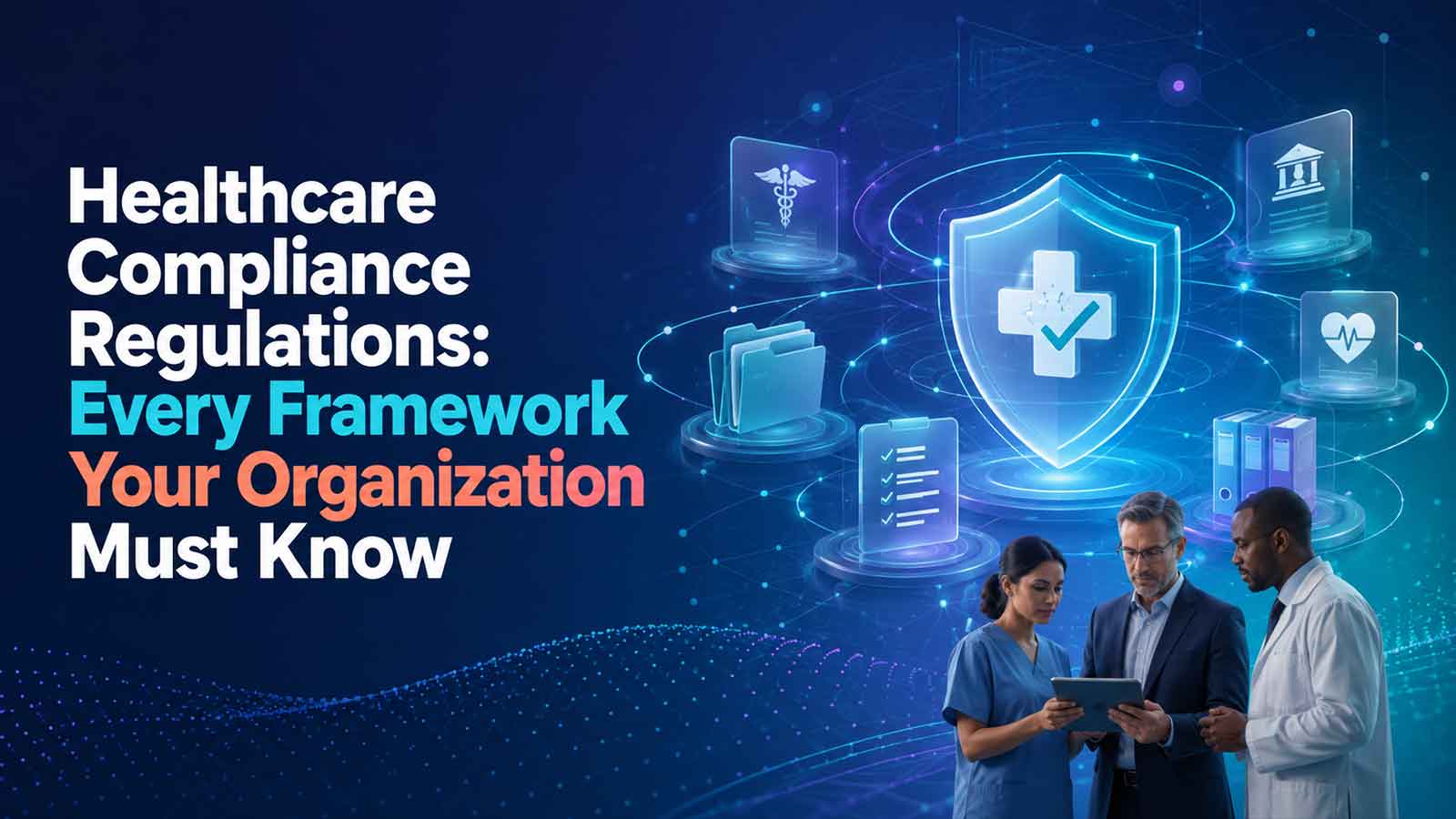
This guide explains the major healthcare compliance regulations every organization should understand, including HIPAA, HITECH, the False Claims Act, Anti-Kickback Statute, Stark Law, CMS Conditions of Participation, EMTALA, 42 CFR Part 2, ONC interoperability requirements, FTC health privacy rules, and other federal and state regulations. It also covers the most important compliance updates for 2025–2026 and practical steps to build a modern, audit-ready compliance program.
What Is Healthcare Regulatory Compliance? A Practical Guide
If your team has ever asked what regulatory compliance in healthcare is, the plain-English answer is this: it is the system your organization uses to follow the law, bill honestly, protect patient information, support safe care and prove it did those things when a regulator, payer, auditor or board member asks. In practice, healthcare compliance laws and regulations are not just legal text. They become workflows for access approvals, incident response, coding review, sanction screening, conflict checks, vendor contracting, data retention and training records.
That is why regulatory compliance in the healthcare industry now sits with more than the compliance officer. IT owns technical safeguards. Privacy teams handle disclosures and breach analysis. Revenue cycle checks claim integrity. Operations keeps policy acknowledgments and escalation paths moving. Practice managers make sure the rule on paper matches the way front-desk staff, clinicians, and billers actually work. When people reduce the job to “HIPAA compliance,” they miss how broad regulatory compliance in healthcare really is.
Why Healthcare Compliance Matters Beyond Avoiding Fines
Privacy is the obvious reason, but it is not the only one. Patients are less likely to trust a provider after a breach, and trust affects disclosure, follow-up, and care seeking. Safety is just as real. HHS says ransomware can delay services and affect patient safety, and a 2023 JAMA Network Open study found a ransomware attack at one health system was associated with disruptions in stroke care metrics at nearby emergency departments. A separate 2024 JAMA Network Open cohort study found that clinician-days with high secure messaging volume were associated with higher odds of wrong-patient orders. That is a direct line from weak governance to operational and clinical risk. (hhs.gov)
Ethics and fraud prevention sit in the same picture. If referral deals distort judgment, if documentation gets copied forward to support claims it should not support, or if executives cannot show who approved what and when, the problem stops being abstract very quickly. False claims exposure, whistleblower complaints, corrective action plans, and contract loss are all part of the same chain of failure. That is the piece many leaders miss when they talk about the consequences of non-compliance in healthcare as if the only risk were an agency fine. (justice.gov)
Essential Healthcare Compliance Regulations Every Organization Should Know
HIPAA starts with three operational pillars. The Privacy Rule governs how covered entities use and disclose protected health information and gives patients rights over their records. The Security Rule requires administrative, physical, and technical safeguards for ePHI. The Breach Notification Rule sets the clock for notifying individuals, HHS, and sometimes the media after a breach. HITECH strengthened enforcement and made breach reporting a core part of the compliance burden. (hhs.gov)
Fraud and abuse rules are the next major block. The False Claims Act punishes knowingly false claims with treble damages and inflation-linked penalties. The Anti-Kickback Statute bars offering or receiving anything of value to induce federal healthcare program referrals. Stark bars certain physician referrals for designated health services when a prohibited financial relationship exists. The Civil Monetary Penalties Law and OIG exclusion authorities add another layer because payment can stop even when the arrangement looked “commercially reasonable” inside the business. (justice.gov)
Providers also need to track participation and care-delivery rules. CMS Conditions of Participation and Conditions for Coverage are what let many organizations enter and stay in Medicare and Medicaid. EMTALA requires Medicare-participating hospitals with emergency services to provide a medical screening exam and stabilizing treatment regardless of ability to pay. For behavioral health and substance use treatment, 42 CFR Part 2 adds stricter confidentiality rules for qualifying records, and the 2024 final rule aligned parts of Part 2 more closely with HIPAA while keeping special protections in place. (cms.gov)
Depending on your product and data flows, other frameworks can matter just as much. ONC information blocking rules and HTI-1 requirements affect certified health IT and data exchange. FTC health privacy and breach rules can apply to health apps that are not covered by HIPAA. FDA oversight can reach software functions that cross into medical device territory. That is why healthcare compliance laws and regulations should be mapped to functions, not memorized as a single list. (healthit.gov)
What Changed in Healthcare Compliance in 2025–2026?
The foundation of healthcare compliance hasn't changed. Core regulations like HIPAA, HITECH, the False Claims Act (FCA), the Anti-Kickback Statute (AKS), Stark Law, exclusion screening, and the OIG's Seven Elements of an Effective Compliance Program remain the backbone of every compliance program.
What has changed is how regulators are enforcing these laws. Recent enforcement actions by the HHS Office for Civil Rights (OCR) continue to focus on organizations that fail to perform proper risk assessments, manage cybersecurity risks, maintain audit logs, monitor system activity, or verify user identities. Although the OIG General Compliance Program Guidance is voluntary, it has become the preferred framework for building strong governance, training, auditing, reporting, and corrective action processes.
Several new requirements are also reshaping compliance priorities in 2026. The proposed HIPAA Security Rule modernization, introduced in January 2025, is still awaiting final approval, but healthcare organizations are already expected to strengthen cybersecurity with updated security policies, better risk management, and stronger technical safeguards. Meanwhile, CMS interoperability rules have moved into implementation, requiring providers and payers to meet new prior authorization and data-sharing deadlines. At the same time, ONC's HTI-1 rule has increased expectations around AI transparency, health data exchange, and information blocking, making AI governance an important part of compliance.
Privacy rules have also evolved. The updated 42 CFR Part 2 regulations now align more closely with HIPAA while continuing to provide additional protections for substance use disorder records. Changes to HIPAA's reproductive health privacy rule have also required organizations to update certain Notices of Privacy Practices, even though parts of the original rule were later struck down by a federal court.
The bottom line is that the core healthcare laws remain the same, but compliance expectations have expanded. In 2026, organizations must focus on cybersecurity, ransomware preparedness, AI governance, interoperability, vendor risk management, and maintaining clear evidence that compliance activities are being performed, not just documented on paper.
The compliance problems that create the most trouble
The biggest compliance issues in healthcare are not mysterious. Inadequate risk analysis sits at the top because OCR keeps identifying it after breaches and settlements. Weak access management follows close behind because stale accounts, broad permissions, and poor authentication make breaches and snooping much easier. Missing or outdated BAAs create avoidable exposure because the vendor relationship may be lawful in practice but unsupported on paper. Insecure messaging and file sharing become a problem when staff routes PHI through tools that lack the right safeguards, retention settings, or audit visibility. (hhs.gov)
On the revenue side, overbilling, unsupported diagnoses, medical necessity problems, kickbacks, and sloppy compensation structures continue to drive DOJ and OIG action. Recent DOJ cases tied to Medicare Advantage risk adjustment and medically unnecessary services show how fast coding and referral decisions become False Claims Act matters. Add incomplete exclusion screening, delayed breach response, poor retention of audit evidence, and AI note-generation or copy-forward practices that blur who actually documented what, and you have the modern shortlist of where compliance effort pays off first. (justice.gov)
How State Healthcare Laws Affect Compliance Requirements
Federal law is the floor, not the whole answer. HHS says HIPAA generally preempts contrary state law unless the state rule is more protective or falls into a recognized exception. That means the right analysis usually starts with the HIPAA baseline, then asks what state law adds. Washington’s My Health My Data Act reaches consumer health data outside HIPAA. California’s CCPA treats health information as sensitive personal information in some contexts, and California has already enforced privacy law against health-related website tracking. Illinois’ biometric rules can matter if your workflow uses fingerprints, facial recognition, or voiceprints for workforce access or patient-facing tools. (hhs.gov)
Healthcare organizations also run into state-specific rules on record access, retention, minors’ confidentiality, and reproductive health. California, for example, requires some licensed providers to preserve records for at least seven years and keep minor records longer, and state law can require notice of unauthorized disclosures within 15 business days in settings where HIPAA’s federal breach framework works differently.
California also enacted additional reproductive-health protections under CMIA, and HHS telehealth guidance reminds providers that licensure, telehealth registration and liability rules vary by state when care crosses state lines. Rules differ by state, so the safest move is to keep a state-law matrix by patient location, provider licensure and data type rather than assuming federal law settles the issue. (leginfo.legislature.ca.gov)
How to Build an Effective Healthcare Compliance Program
A usable program still looks a lot like OIG’s model: clear governance and reporting lines, written policies, education and training, confidential reporting channels, auditing and monitoring, prompt response and corrective action, and leadership oversight. The difference between a paper program and a working one is evidence. Governance needs committee charters and board minutes. Policies need version history and approvals. Training needs attendance logs and role-based completion reports. Reporting channels need case logs and non-retaliation follow-up. Auditing needs workpapers, findings, and remediation dates. Vendor management needs BAAs, security questionnaires, and renewal reviews.
This is also where we see teams struggle with sprawl. A policy may live in one system, a vendor review in email, a tabletop report in a shared drive, and a corrective action tracker in a spreadsheet. If that sounds familiar, the work usually improves when it moves into one governed place such as our intelligent repository, workflow automation, and compliance audit trail setup. If you already have a mature GRC stack tightly integrated with your EHR and identity tools, replacing it may create more churn than value. But if evidence is scattered, consolidation is often the faster fix.
The Real Cost of Healthcare Non-Compliance
The consequences of non-compliance in healthcare are rarely limited to the legal team. They show up as OCR settlements, repayment demands, corrective action plans, treble-damages exposure under the False Claims Act, exclusion risk, breach response costs, downtime, delayed claims, failed integrations, contract loss, and public trust that is slow to rebuild. The right framework depends less on your industry label than on your role, your data flows, and whether you can prove the work happened the way your policy says it should.
Strengthen Healthcare Compliance with Centralized Governance
Use this as a working checklist, not a one-time read. If your compliance work lives across inboxes, shared drives, and hallway follow-ups, see how we at TeamSync help healthcare teams keep policies, approvals, training, incident response, and audit evidence in one place. Get in touch.