On this page
- What Is an IT Security Audit?
- What Security Audits Evaluate in an Enterprise Environment
- IT Security Audit vs. Security Assessment vs. Compliance Audit
- Types of Cybersecurity Audits Organizations Should Know
- How the IT Security Audit Process Works Step by Step
- Step 1: Define the Audit Scope
- Step 2: Inventory Assets and Controls
- Step 3: Collect Evidence
- Step 4: Test Controls and Assess Risks
- Step 5: Report Findings and Remediate
- Step 6: Validate and Follow Up
- Who Participates in a Computer Security Audit
- Common Findings and Mistakes That Delay Security Audits
- How Collaboration Improves Audit Readiness and Remediation
- Conclusion: Turn Security Audits Into an Ongoing Risk Reduction Practice
- Ready to Streamline Audit Coordination Across Teams?
An IT security audit matters because the cost of getting security wrong keeps rising. IBM’s Cost of a Data Breach Report 2024 found that the global average cost of a breach reached $4.88 million, a record high. Verizon’s 2025 Data Breach Investigations Report also reported that human involvement remains a major factor in breaches, showing that technology alone does not reduce risk if access, process, and training controls are weak. At the governance level, NIST’s risk management guidance continues to emphasize control assessment and continuous monitoring as core parts of effective cybersecurity risk management.
That pressure is colliding with major workplace changes.
AI is reshaping the way enterprises operate, from smarter collaboration to faster decision-making. But as organizations adopt AI-powered workplace tools at scale, they’re also facing new challenges around data governance, visibility, and security. The rise of shadow AI, where employees use unapproved AI applications, has made it harder for security teams to track sensitive information and enforce consistent controls across the business.
This shift has changed the role of security audits. They’re no longer just about checking compliance or reviewing technical controls once a year. Today, an effective IT security audit helps organizations understand where risks exist, validate that security measures are working as intended, and build a repeatable framework for managing evolving threats. In an environment where AI adoption is accelerating, regular security audits have become an essential part of maintaining trust, protecting critical data, and strengthening enterprise resilience.
What Is an IT Security Audit?
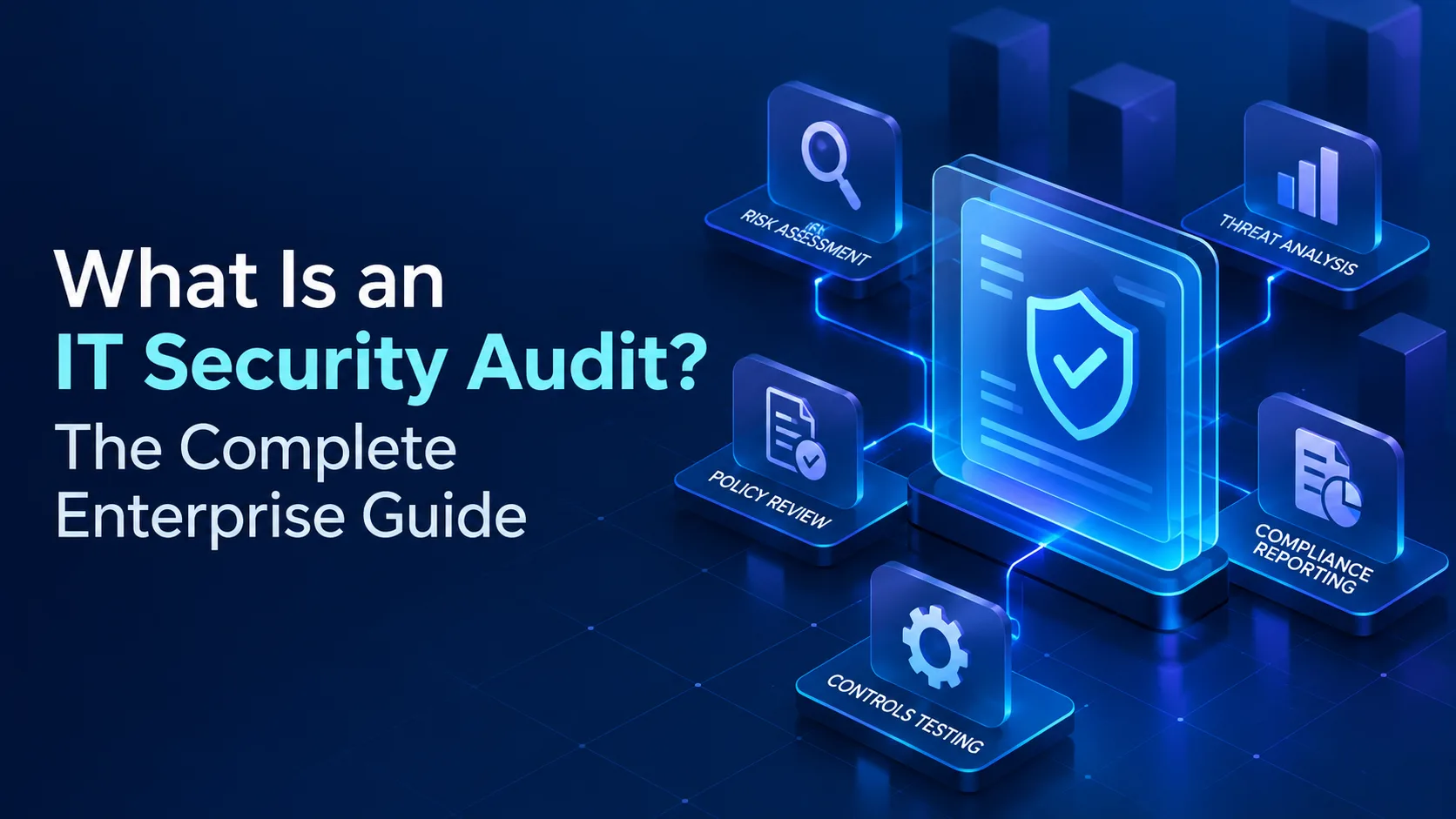
An IT security audit is a systematic evaluation of an organization's IT environment, including its systems, security controls, policies, and processes, to determine whether they effectively protect sensitive data, support business operations, and meet regulatory or internal compliance requirements.
Whether you're searching for what is a security audit, what is an information security audit, or what is an IT security audit, the concept remains the same. A security audit is built on evidence, not assumptions. It verifies that access controls are enforced, systems are securely configured, policies are documented, responsibilities are clearly defined, and security measures are consistently followed across the organization.
This is what sets an IT security audit apart from day-to-day security operations. While security teams focus on monitoring threats, responding to incidents, and maintaining security tools in real time, an audit takes a broader view. It assesses whether the organization's overall security framework is well-designed, operating effectively, and backed by the documentation needed to demonstrate compliance and accountability.
Rather than simply identifying vulnerabilities, a security audit helps organizations validate that their controls are working as intended, uncover gaps before they become risks, and build a stronger foundation for long-term cybersecurity resilience.
What Security Audits Evaluate in an Enterprise Environment
In a large organization, security audits span far more than firewalls and antivirus software. Auditors review the control environment across people, process, and technology, and they look for evidence that each area is governed consistently.
Access controls and identity management: Auditors examine how user accounts are created, approved, changed, and removed, and whether authentication practices such as MFA reduce the chance of unauthorized access.
Endpoint, network, and cloud security: Reviews often cover device configuration, patching, segmentation, remote access, cloud permissions, and whether misconfigurations could expose systems or data.
Application and data protection controls: Auditors look at secure development practices, vulnerability handling, encryption, retention, backup, and recovery readiness because business continuity depends on more than prevention.
Monitoring, response, third parties, and workforce behavior: Logging, alerting, incident response plans, vendor oversight, and employee security awareness all matter because many enterprise failures happen at the seams between teams.
These domains show why security audits are inherently cross-functional. The audit does not only ask whether a control exists. It asks whether the control is appropriate, documented, used consistently, and tied to a clear owner.
IT Security Audit vs. Security Assessment vs. Compliance Audit
Although the terms are often used interchangeably, an IT security audit, a security assessment, and a compliance audit serve different purposes.
An IT security audit is focused on validation. It examines documented evidence to determine whether security controls are designed effectively, operating as intended, and aligned with established policies or standards. Auditors rely on tangible proof such as system configurations, access logs, approval records, change requests, and documented procedures to verify that security practices are consistently followed.
A security assessment, on the other hand, takes a broader and more strategic view of an organization's cybersecurity posture. Instead of validating existing controls, it identifies potential risks, evaluates security maturity, reviews architecture, analyzes vulnerabilities, and provides recommendations for strengthening the overall security program. The goal is to understand where the organization stands today and what improvements should be prioritized.
A compliance audit has a more specific objective. It determines whether an organization meets the requirements of a particular framework, regulation, or contractual obligation, such as ISO 27001, SOC 2, HIPAA, or PCI DSS. Rather than assessing overall security maturity, it focuses on demonstrating adherence to predefined compliance criteria.
For many organizations, these activities work together rather than independently. Regular IT security audits help strengthen internal controls, making compliance assessments smoother and reducing the effort required during formal certifications or regulatory reviews. Beyond meeting compliance requirements, audit readiness reflects a mature security program that supports stronger governance, better risk management, and greater confidence among customers, partners, and stakeholders.
Types of Cybersecurity Audits Organizations Should Know
Different audit types serve different business, operational, and regulatory needs. The right approach depends on your systems, industry, customer obligations, and recent risk events.
Audit type | What it focuses on | Best use case |
Internal audit | Controls reviewed by internal teams or internal audit functions | Routine governance and preparation before external review |
External audit | Independent validation by a third party | Building customer, board, or regulator confidence |
Compliance audit | Alignment to standards or regulations | ISO 27001, SOC 2, HIPAA, PCI DSS, or sector-specific mandates |
Physical security audit | Facility, device, and environmental protections | Offices, data centers, and high-sensitivity operational sites |
Technical control audit | Configuration and operating effectiveness of security tools and systems | Verifying privileged access, logging, patching, or segmentation controls |
Cloud security audit | Cloud architecture, identity, storage, and workload controls | Multi-cloud or SaaS-heavy environments |
Third-party or vendor audit | Security posture of suppliers and service providers | Managing supply chain and outsourcing risk |
Post-incident audit | Review after a breach or major security event | Identifying root causes and validating corrective action |
In practice, many organizations combine these. A healthcare provider may run an internal audit to prepare for HIPAA oversight, while a financial services firm may layer vendor audits and cloud reviews into a broader annual program. The key is understanding that the types of cybersecurity audits are tools for different decisions, not interchangeable labels.
How the IT Security Audit Process Works Step by Step
The audit lifecycle usually begins with scope definition. The organization identifies which systems, business units, locations, regulations, and control objectives are in scope. Without clear boundaries, audits become slow, expensive, and difficult to complete.
Step 1: Define the Audit Scope
Identify the systems, business units, locations, regulations, and control objectives to be audited. A clearly defined scope keeps the audit focused, efficient, and cost-effective.
Step 2: Inventory Assets and Controls
Document critical assets, system owners, data types, and applicable policies or compliance standards. This stage often uncovers documentation gaps before testing begins.
Step 3: Collect Evidence
Gather supporting evidence such as policies, procedures, access reviews, configuration reports, screenshots, training records, incident logs, vendor documentation, and change management records. Interviews help verify that documented processes are followed in practice.
Step 4: Test Controls and Assess Risks
Evaluate whether security controls are properly designed and operating effectively. Issues such as excessive user privileges, missing logs, or untested backups are assessed based on their likelihood and business impact.
Step 5: Report Findings and Remediate
Document audit findings, assign action owners, establish remediation timelines, and track corrective actions until evidence confirms the issues have been resolved.
Step 6: Validate and Follow Up
Review implemented fixes to ensure they effectively address the identified risks. Follow-up validation confirms that corrective actions are complete and the organization remains compliant.
An effective information security audit is more than a compliance checklist; it relies on strong documentation, clear accountability, and collaboration across teams to strengthen the organization's overall security posture.
Who Participates in a Computer Security Audit
A computer security audit is rarely owned by the security team alone. IT operations, security, compliance, legal, HR, procurement, department leaders, and executive sponsors all play a role, especially when identity, vendor access, employee onboarding, records retention, or regulated data are involved. External auditors may also participate when the review supports certification, attestation, or customer assurance requirements.
In modern enterprises, shared visibility is essential. Evidence may live across ticketing systems, shared drives, cloud consoles, policy folders, email threads, and vendor portals. That fragmentation slows reviews and increases disruption. Centralized systems for document management, workflow ownership, and audit traceability make it much easier to keep the process moving.
Common Findings and Mistakes That Delay Security Audits
Many audit delays come from familiar weaknesses. Policies may be outdated, user access may be broader than necessary, or asset inventories may not reflect what is really deployed. In other cases, change management records are incomplete, logs are not retained long enough, backups have not been tested, or shadow IT introduces tools that were never formally reviewed.
Vendor risk is another common issue. Organizations often rely on third parties for storage, collaboration, analytics, or support, but fail to maintain current contracts, security questionnaires, or assurance reports. Poor evidence collection creates the final layer of friction. A control may exist, but if no one can quickly produce approvals, reports, or test results, the audit stalls.
The best prevention strategy is operational discipline between audit cycles. Clear ownership, periodic access reviews, version-controlled policies, tested recovery procedures, and governed documentation repositories all reduce last-minute scrambling and improve audit outcomes.
How Collaboration Improves Audit Readiness and Remediation
Audit readiness improves when the work of security, IT, compliance, and operations happens in a shared system instead of across disconnected tools. Teams need a reliable way to organize policies, collect evidence, assign owners, route approvals, and track remediation tasks over time. That is especially true when audits involve multiple departments, distributed teams, and external reviewers.
A centralized collaboration platform like TeamSync can support that process by giving enterprises one governed workspace for document control, workflow coordination, and audit visibility. Capabilities such as an intelligent repository, workflow automation, and a dedicated compliance audit trail help teams reduce duplication, maintain cleaner records, and keep remediation work moving before, during, and after security audits.
Conclusion: Turn Security Audits Into an Ongoing Risk Reduction Practice
An IT security audit is a structured way to verify controls, uncover weaknesses, support compliance, and improve organizational resilience. The strongest results come when audits are treated as part of continuous governance, not as a one-time project completed under deadline pressure.
Ready to Streamline Audit Coordination Across Teams?
Learn how TeamSync can help your organization centralize audit documentation, coordinate remediation, and keep every stakeholder aligned for a smoother IT security audit process. Explore the TeamSync platform, review its security capabilities, or contact the TeamSync team to see how a centralized workspace can improve audit coordination across your enterprise.