On this page
- What Is Financial Compliance?
- Financial Compliance vs Financial Regulatory Compliance vs Financial Crime Compliance
- Who Is In Scope: Banks Broker-Dealers Insurers Lenders Fintechs
- Prudential vs Conduct vs Market Regulation
- The Regulation Map
- Regulatory Compliance in Banking
- What Bank Examiners Look At:
- The Examination Cycle and How to Prepare
- Consent Orders and What Triggers Them
- Mortgage Regulatory Compliance
- TRID RESPA HMDA and the Loan File
- Why Mortgage Is a Document Retention Problem First
- Compliance and Risk Management in Banking
- Document management and workflow automation make compliance easier only when the audit trail is defensible
- Staying examination-ready comes down to clear scope clean evidence and a system your team can trust under pressure
- See how TeamSync helps regulated teams keep records organized searchable and ready for the next exam
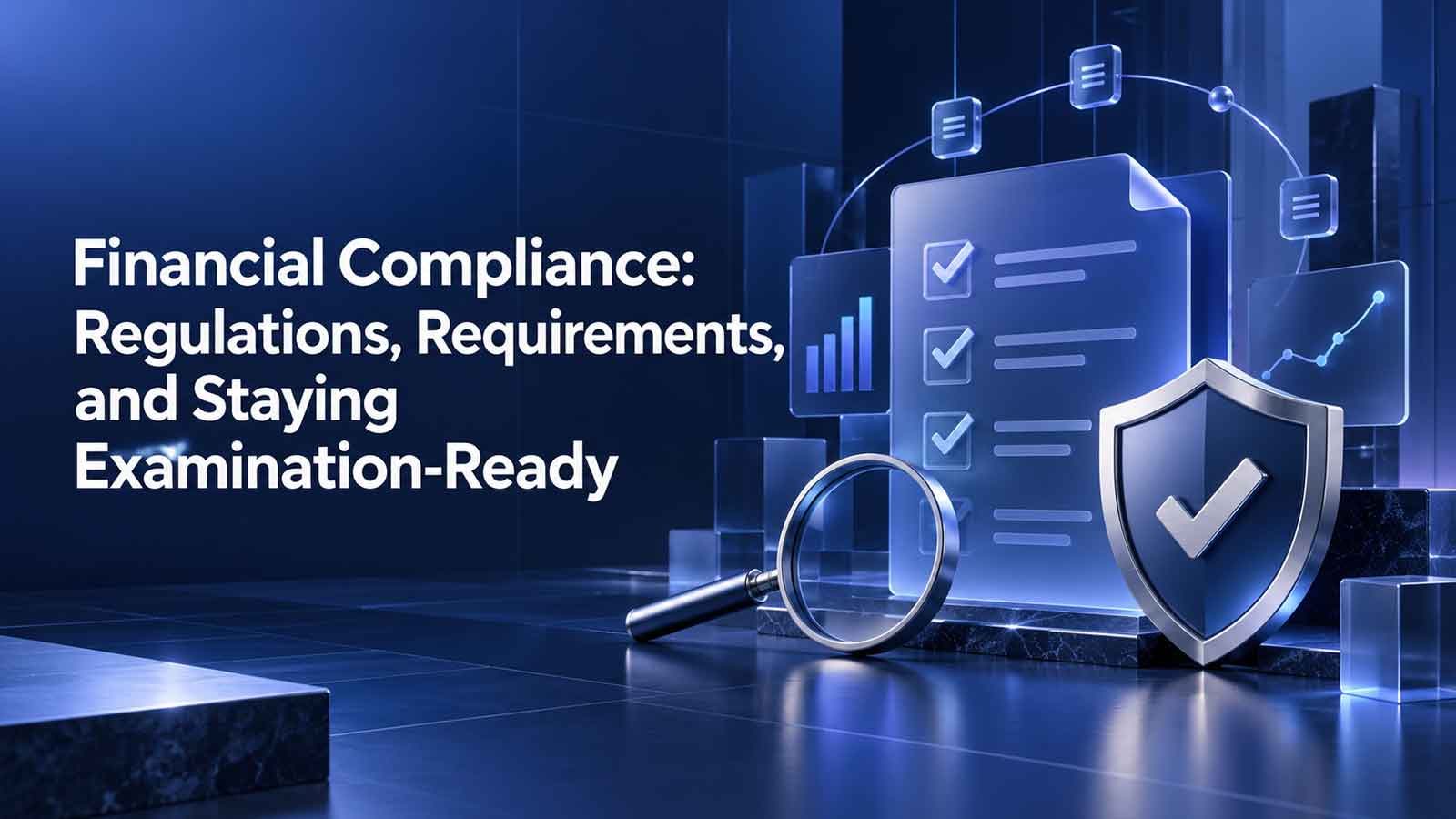
Financial Compliance: Regulations, Requirements, and Staying Examination-Ready
The cost of getting compliance wrong is not theoretical anymore. In fiscal year 2024 the SEC filed 583 total enforcement actions and obtained $8.2 billion in financial remedies. The CFPB says it has delivered more than $21 billion in consumer relief since 2011. The FBI’s latest Internet Crime Report says cyber-enabled crime defrauded Americans of nearly $21 billion in 2025 alone. Those numbers point to the same reality: regulators do not just care whether a firm has a policy. They care whether the firm can produce records, show operating controls, explain decisions and respond under pressure.
Financial compliance is constantly evolving, and staying examination-ready requires more than just meeting regulatory requirements. In this guide, we'll cover the fundamentals of financial compliance, the key regulations impacting banks, lenders, insurers, and fintechs, what examiners look for during audits, and how effective document management, workflow automation, and audit trails help organizations stay compliant and prepared with TeamSync.
What Is Financial Compliance?
Financial compliance is the day-to-day work of turning legal obligations into operating controls. That means the laws, regulations, supervisory expectations, standards and internal controls that govern how firms handle money, disclosures, customer onboarding, lending, investing, reporting, fraud prevention, sanctions screening, privacy and recordkeeping. We are focused here on practical operations: who owns the rule, what control proves compliance and where the evidence lives.
Financial Compliance vs Financial Regulatory Compliance vs Financial Crime Compliance
Financial compliance is the broad umbrella. Financial regulatory compliance usually means satisfying the rulebooks and supervisory expectations issued by bodies such as the SEC, CFPB, OCC, FDIC, the Federal Reserve, FINRA, FinCEN and state regulators. Financial crime compliance is narrower and usually centers on AML, KYC, sanctions screening, fraud monitoring and suspicious activity escalation. One bank can sit inside all three at once: it may need fair lending controls for regulators, books and records controls for examinations and AML alert review for financial crime obligations.
Who Is In Scope: Banks Broker-Dealers Insurers Lenders Fintechs
The scope is wider than most teams expect. Banks and credit unions live under prudential supervision, consumer protection and BSA/AML expectations. Broker-dealers and RIAs face heavy books and records, communications and investor-protection demands. Insurers deal with state exams, claims documentation and privacy obligations. Mortgage lenders and servicers carry one of the densest burdens in the market, which is why mortgage regulatory compliance often becomes a records and workflow challenge before it becomes a legal one. Fintechs and payment companies often combine money movement, vendor risk, card controls and state licensing. Public companies and even non-financial businesses with treasury, sanctions or card-payment exposure still carry real financial industry compliance obligations.
Prudential vs Conduct vs Market Regulation
It helps to sort the rulebook into three lenses. Prudential regulation is about safety and soundness: capital, liquidity, governance, operational resilience and risk management. Conduct regulation is about customer treatment: disclosures, complaints, suitability, UDAAP and fair lending. Market regulation is about trading, transparency, issuer disclosure, investor protection and books and records. A large bank can face all three at once through deposit products, securities activity and public-company reporting.
The Regulation Map
The right question is not “what are the rules for finance?” It is “which rules apply to our products, customers, licenses, jurisdictions and reporting obligations?” A bank, a broker-dealer, a mortgage servicer and a public manufacturer all touch financial compliance differently. Add GLBA, Dodd-Frank, BSA/AML and card obligations such as PCI DSS and the overlap gets real fast.
Regulatory Compliance in Banking
When people search regulatory compliance in banking they usually mean the daily discipline of aligning onboarding, lending, disclosures, transaction monitoring, complaint handling, third-party oversight, access controls, retention and board reporting to regulator expectations. Good banking compliance regulations work is not a memo on a shelf. Good banking regulatory compliance means the process, the system and the evidence all line up. When someone says regulatory compliance banking or asks about risk and compliance in banking they are usually asking whether controls hold up when the examiner starts testing.
What Bank Examiners Look At:
Examiners usually start with a practical checklist and then test whether the control was well designed and whether it operated consistently:
governance, management tone and a current risk assessment
the policy framework and whether rules are mapped to actual processes
BSA/AML controls, KYC and CIP execution and suspicious activity escalation
fair lending monitoring, complaint handling and sanctions screening
access management, vendor oversight and change management
training completion, issue remediation and evidence quality
transaction samples that prove approvals, exceptions and review steps really happened
The Examination Cycle and How to Prepare
A typical cycle runs from pre-exam requests to document production, walkthroughs, transaction testing, management responses, findings, remediation and follow-up. The cleanest prep sequence is straightforward: maintain an obligations register, map controls to regulations, centralize evidence, rehearse responses and run a mock exam before the request list lands. We keep seeing the same thing in our work: teams rarely fail because they cannot describe a policy. They fail because retrieval across shared drives, email and line-of-business systems breaks down when time pressure hits.
Consent Orders and What Triggers Them
Consent orders and similar actions matter because they turn a compliance failure into a multiyear operating project. Common triggers include repeated control failures, weak AML governance, unsafe or unsound practices, fair lending issues, inaccurate reporting, poor board oversight and failure to fix prior findings. The legal document gets the headline. The operational burden is what changes the business.
Mortgage Regulatory Compliance
Mortgage regulatory compliance is where financial compliance becomes visibly document-heavy. Mortgage teams sit at the intersection of consumer disclosures, underwriting support, timing rules, servicing obligations, fair lending, data reporting and state retention requirements. State-by-state variation adds another layer, so expansion into a new lending market should always include local rule review.
TRID RESPA HMDA and the Loan File
In mortgage operations the rule set shows up directly in the file. TRID drives timing and disclosure accuracy. RESPA shapes settlement and servicing requirements. HMDA drives data collection and reporting. ECOA affects fair lending and adverse action. FCRA governs credit report use and related notices. Flood rules can add their own documentation. In practice that means the real audit trail spans the LOS, PDF disclosures, email, call notes, approvals, exceptions, servicing history and change logs.
Why Mortgage Is a Document Retention Problem First
Picture an examiner asking for a single loan story across origination and servicing. The answer may live in email, the LOS, signed disclosures, servicing notes, vendor systems and state-specific retention rules. The rule itself is only half the problem. The harder half is proving completeness, version history, who reviewed what and when and whether the file can be reconstructed quickly and defensibly.
Compliance and Risk Management in Banking
Compliance and risk management in banking are close cousins but not the same function. Compliance translates regulatory obligations into policies, controls, monitoring and remediation. Risk management identifies, measures, escalates and governs the broader risk profile across credit, market, liquidity, operational, cyber, conduct and compliance risk.
Document management and workflow automation make compliance easier only when the audit trail is defensible
This is where technology earns its keep. In regulated environments a platform should centralize records, apply retention schedules, preserve version history, automate approvals and attestations, support legal holds, speed up retrieval and maintain secure searchable access across teams. Generic file storage is not enough. Examination-ready document management needs governance and evidence built in.
That is the logic behind our:
AI can help with search, classification and retrieval through tools like DocuTalk AI, but only when permissions, validation and human oversight are in place.
Staying examination-ready comes down to clear scope clean evidence and a system your team can trust under pressure
Financial compliance is not one rulebook. It is a stack of obligations shaped by business model, product set, regulator footprint and risk profile. The practical path is consistent across sectors: define scope, map regulations, assign owners, build controls, keep evidence organized, measure performance and rehearse for examinations before the request list arrives. When the pressure comes, the firms that respond well are usually the ones that can show both the rule and the proof.
See how TeamSync helps regulated teams keep records organized searchable and ready for the next exam
Get in touch to book a TeamSync demo and see how we help regulated teams centralize compliance records, automate review workflows and stay examination-ready with secure search, retention controls and a defensible audit trail.