On this page
- Cybersecurity Audit Checklist: What it is and what enterprise teams should expect
- Before the audit: scope systems, owners, and evidence
- Core cyber security audit checklist for enterprise teams
- Security audit procedures: how to review controls without slowing down the business
- Regular security audits and assessments versus one-time checkups
- Turning audit findings into a remediation plan teams will actually follow
- Conclusion: Build a repeatable security audit checklist into team operations
- CTA: Use a collaboration system that helps teams document, assign, and complete audit work
Enterprise teams do not need another abstract warning about cyber risk; they need a practical way to verify whether everyday systems, access decisions, and collaboration habits are still defensible.
Recent incidents have made that even clearer. In April 2026, Vercel disclosed that some internal systems were accessed after a compromise involving a third-party tool, a sharp example of how SaaS integrations and cloud identities can turn a vendor issue into an enterprise issue. Coverage in 2026 has also highlighted the growing security burden around SaaS identities, guest access, and externally shared data, especially in collaboration-heavy environments. For enterprise leaders, the lesson is simple: if your teams cannot quickly review permissions, document evidence, and track remediation across tools, your audit process is too weak for the environment you are operating in.
See reporting from TechCrunch and ITPro.
That is why a strong cybersecurity audit checklist matters now. It turns broad concern into a repeatable review process that enterprise teams can actually run.
Cybersecurity Audit Checklist: What it is and what enterprise teams should expect
A cybersecurity audit checklist is a structured way to verify whether your security controls, team processes, and supporting evidence match the risk you actually carry. It is not just a compliance artifact for a yearly review. A useful cybersecurity audit checklist helps teams inspect how access is granted, how sensitive data moves, how vendors connect into the environment, and how employees interact with systems every day.
For enterprise teams, this means the checklist should cover both technical controls and operating behavior. IT may provide configuration evidence, security may validate enforcement and monitoring, HR may support onboarding and offboarding proof, operations may document workflow dependencies, and department leaders may confirm who really needs access to which tools. In that sense, a security audit checklist is also an accountability tool.
It is also important to separate one-time review activity from regular security audits and assessments. A single annual audit may confirm whether required controls exist. Ongoing assessments help you determine whether those controls still work after new apps are added, teams change, vendors expand, and permissions drift. In fast-moving enterprises, the second question is usually the more important one.
Before the audit: scope systems, owners, and evidence
Before you apply any checklist, define the scope. Start with business-critical assets, then map the systems and workflows that support them. That usually includes identity providers, collaboration platforms, cloud storage, endpoint fleets, administrative consoles, line-of-business SaaS tools, and the sensitive data flows between them.
Next, assign an accountable owner for each system or control area. This step is often skipped, but it is essential for efficient security audit procedures. Auditors and internal reviewers should know who can explain a setting, produce logs, confirm exceptions, or approve remediation. If ownership is vague, evidence collection slows down, and findings remain unresolved longer than they should.
Then gather the artifacts that will make the review meaningful. These may include policies, standards, prior audit findings, incident summaries, vulnerability reports, access review records, backup test results, and proof of remediation from earlier cycles. Teams that keep this information centralized, rather than scattered across inboxes and shared drives, usually complete reviews faster and with fewer blind spots. A governed workspace such as TeamSync - Home: TeamSync - The all-in-one team collaboration platform or its Compliance Reporting & Audit Trail Software capability can help organize this evidence so reviews are less reactive.
Core cyber security audit checklist for enterprise teams
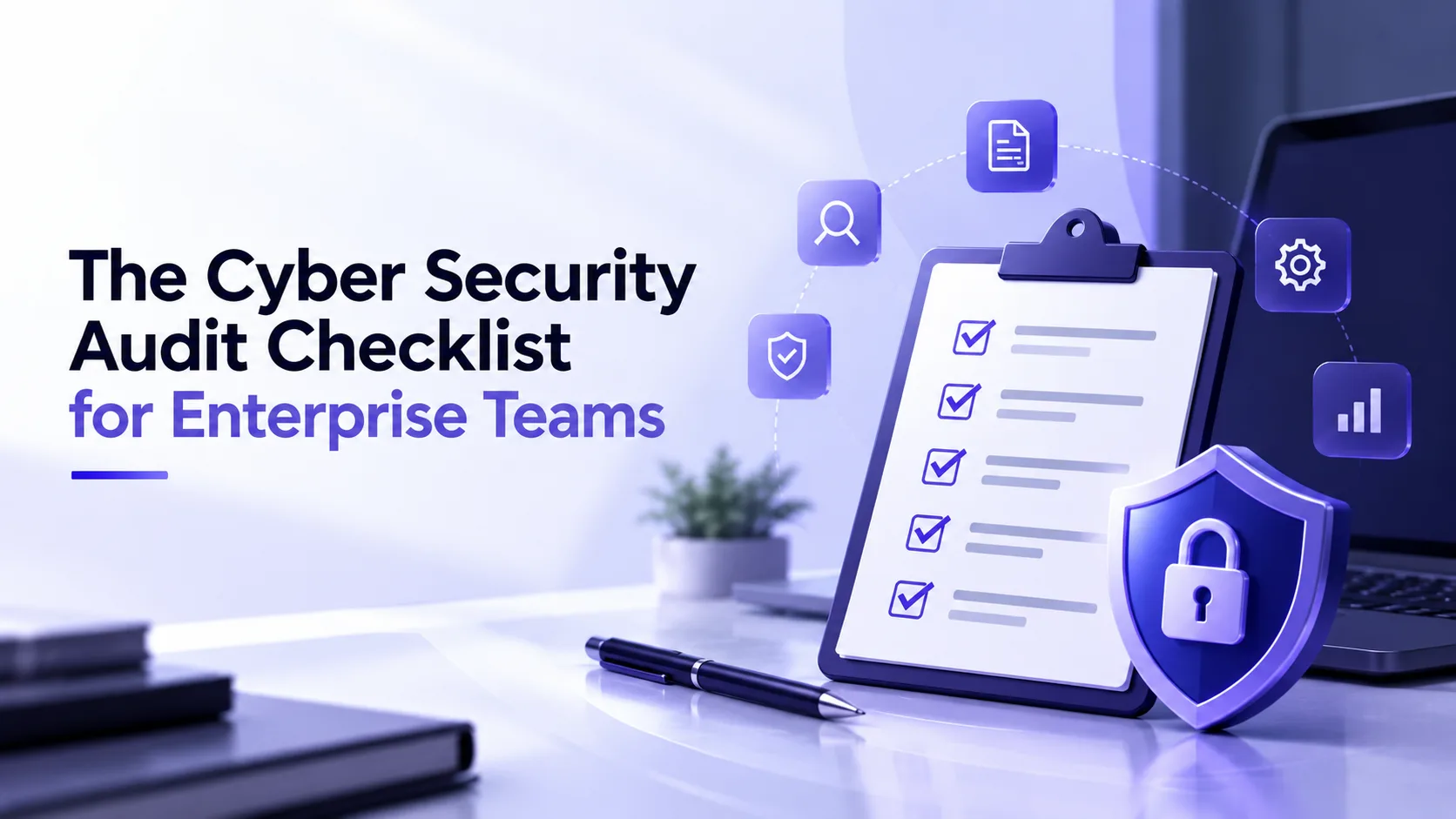
The most effective cyber security audit checklist is one that reviewers can use consistently across systems and quarters. The categories below give enterprise teams a practical baseline.
Asset inventory:
Verify that the organization maintains a current inventory of devices, cloud services, administrative accounts, and business-critical applications. Request inventory exports, CMDB records, and SaaS discovery reports. Common gaps include orphaned tools, unknown shadow IT, and assets with no named owner.
Identity and access management:
Confirm that user provisioning, role changes, and offboarding are controlled through documented workflows. Review joiner, mover, and leaver evidence, plus recent access certifications. Common gaps include stale accounts and role-based access that no longer reflects actual job duties.
Multi-factor authentication:
Verify MFA is enforced for workforce users, remote access, administrators, and sensitive apps. Review policy screenshots, conditional access settings, and exception logs. Common gaps include legacy protocol bypasses and unapproved exemptions.
Privileged access:
Check how admin rights are approved, segmented, monitored, and reviewed. Request privileged access logs, break-glass procedures, and role assignments. Common gaps include standing admin access and shared privileged credentials.
Endpoint protection:
Confirm endpoints are covered by EDR, disk encryption, and device health policies. Review management-console reports and exception lists. Common gaps include unmanaged contractor devices and inactive agents.
Patch and vulnerability management:
Verify patch SLAs, scanning frequency, and closure rates for critical findings. Request scan reports, remediation tickets, and exception approvals. Common gaps include aging vulnerabilities on internet-facing systems and weak ownership of non-server assets.
Backup and recovery:
Check that backups are successful, protected, and regularly tested for restoration. Review backup dashboards, recovery test results, and retention settings. Common gaps include untested restores and unclear recovery priorities.
Data classification and retention:
Confirm that sensitive data is classified, stored appropriately, and retained according to policy. Review classification standards, retention schedules, and sample records. Common gaps include over-retention and sensitive files stored in ungoverned locations.
Encryption:
Verify encryption in transit and at rest for critical systems, endpoints, and repositories. Request architecture documentation and control settings. Common gaps include inconsistent key management and exceptions for legacy systems.
Logging and monitoring:
Confirm that key security events are logged, centralized, retained, and reviewed. Review SIEM coverage, alert logic, and sample event trails. Common gaps include missing SaaS audit logs and low visibility into admin actions.
Incident response readiness:
Verify incident plans, escalation paths, tabletop exercises, and contact lists. Request recent exercise notes and post-incident improvements. Common gaps include outdated contact trees and playbooks that do not reflect current tools.
Third-party and vendor access:
Check how vendors are approved, integrated, monitored, and removed. Review vendor inventories, access approvals, and OAuth or API connection lists. Common gaps include excessive third-party permissions and weak review cadence.
Remote work and device policies:
Verify policy coverage for remote access, BYOD, local storage, and unmanaged networks. Request policy acknowledgments and technical enforcement evidence. Common gaps include policy language with no enforcement mechanism.
Collaboration platform permissions:
Confirm permission groups, guest access, external sharing, and workspace sprawl are regularly reviewed. Request admin-console settings, sample permission audits, and exception approvals. Common gaps include broad default sharing and inactive external collaborators.
Employee security awareness:
Review phishing training, policy attestations, and targeted education for high-risk roles. Common gaps include generic awareness programs with no follow-up for repeat failures.
Policy review cadence:
Verify security policies and standards are reviewed on a defined schedule and updated after incidents or material environment changes. Common gaps include outdated policies that no longer match real operations.
A mature enterprise will adapt this cybersecurity audit checklist to its environment, but these core areas usually reveal the most meaningful weaknesses first.
Security audit procedures: how to review controls without slowing down the business
A checklist is only useful if the review process is practical. Strong security audit procedures combine interviews, configuration reviews, sample-based testing, and evidence validation. In practice, that means speaking with control owners, reviewing live settings in identity and SaaS admin consoles, sampling user permissions, inspecting logs for high-risk events, and testing whether policy requirements are reflected in actual workflows.
The fastest reviews usually rely on repeatable documentation patterns. If teams use one governed repository for policies, approvals, change records, and remediation tasks, reviewers spend less time chasing screenshots and email threads. A platform such as Document Management and Workflow Platform paired with Enterprise Process Automation can help centralize evidence collection, route approvals, and make follow-up work visible without creating more tool sprawl.
The key is not to audit everything at the same depth every time. Focus deeper testing on privileged access, sensitive data paths, third-party integrations, and collaboration settings that have changed recently. That keeps the review efficient while still exposing the highest-risk gaps.
Regular security audits and assessments versus one-time checkups
Annual reviews still have value, but they are rarely enough for enterprises that constantly add apps, move people between roles, and expand partner access. Regular security audits and assessments create a rhythm that matches the way enterprise environments actually change.
Dimension | Regular security audits and assessments | One-time or reactive reviews |
Cadence | Monthly, quarterly, or event-driven | Annual or after an incident |
Depth | Focused, repeatable testing on high-risk areas | Broader, often rushed review |
Ownership | Shared across control owners and business teams | Concentrated in audit or security teams |
Outcomes | Faster remediation, less drift, better evidence quality | More surprises, more stale findings, weaker follow-through |
When audits become routine, teams spot permission drift earlier, remove unnecessary vendor access faster, and update evidence before deadlines create panic. One-time checkups often identify real issues, but they do so after control gaps have already had months to accumulate.
Turning audit findings into a remediation plan teams will actually follow
A good audit does not end with a spreadsheet of problems. Findings need to be prioritized by risk severity, business impact, and implementation effort. A low-effort control fix that reduces broad exposure, such as tightening guest sharing defaults, may deserve attention before a more complex issue with narrower exposure.
Each finding should have a named owner, a due date, supporting evidence, and a documented rationale if the organization accepts or defers the risk. This is where collaboration discipline matters. Teams need one place to track discussions, approvals, dependencies, and proof of closure. For organizations with regulated requirements or leadership reporting needs, TeamSync Capabilities and the Audit defensibility solution can support clearer evidence trails and operational follow-through.
The measurable outcomes are practical. Enterprises often see reduced admin sprawl, faster patch cycles, cleaner vendor access reviews, stronger offboarding discipline, and better incident readiness when audit findings are treated as operational work instead of compliance leftovers.
Conclusion: Build a repeatable security audit checklist into team operations
A strong security audit checklist is more than a comprehensive list of controls; it is a practical framework for continuous improvement. It should be repeatable, risk-focused, and easy for teams to follow, ensuring that security audits are both efficient and effective. When visibility, accountability, and evidence come together, organizations can identify risks faster, strengthen compliance, and turn audit findings into meaningful security improvements that protect everyday operations.
CTA: Use a collaboration system that helps teams document, assign, and complete audit work
Ready to make your cybersecurity audit checklist actionable? Review how your team documents evidence, assigns remediation, and tracks security follow-through, then explore how TeamSync can help centralize collaboration around regular security audits and assessments.