On this page
- Healthcare IT Compliance Explained
- Key Healthcare IT Compliance Regulations You Need to Know
- Healthcare IT Compliance Controls: From HIPAA to the Cures Act
- What regulators are scrutinizing right now
- A 30-60-90 Day Healthcare IT Compliance Roadmap
- How to Build Audit-Ready Healthcare IT Documentation
- Common Healthcare IT Compliance Challenges and Edge Cases
- Build a Continuous Healthcare IT Compliance Program
- See how TeamSync can organize your compliance work across IT, security, and operations
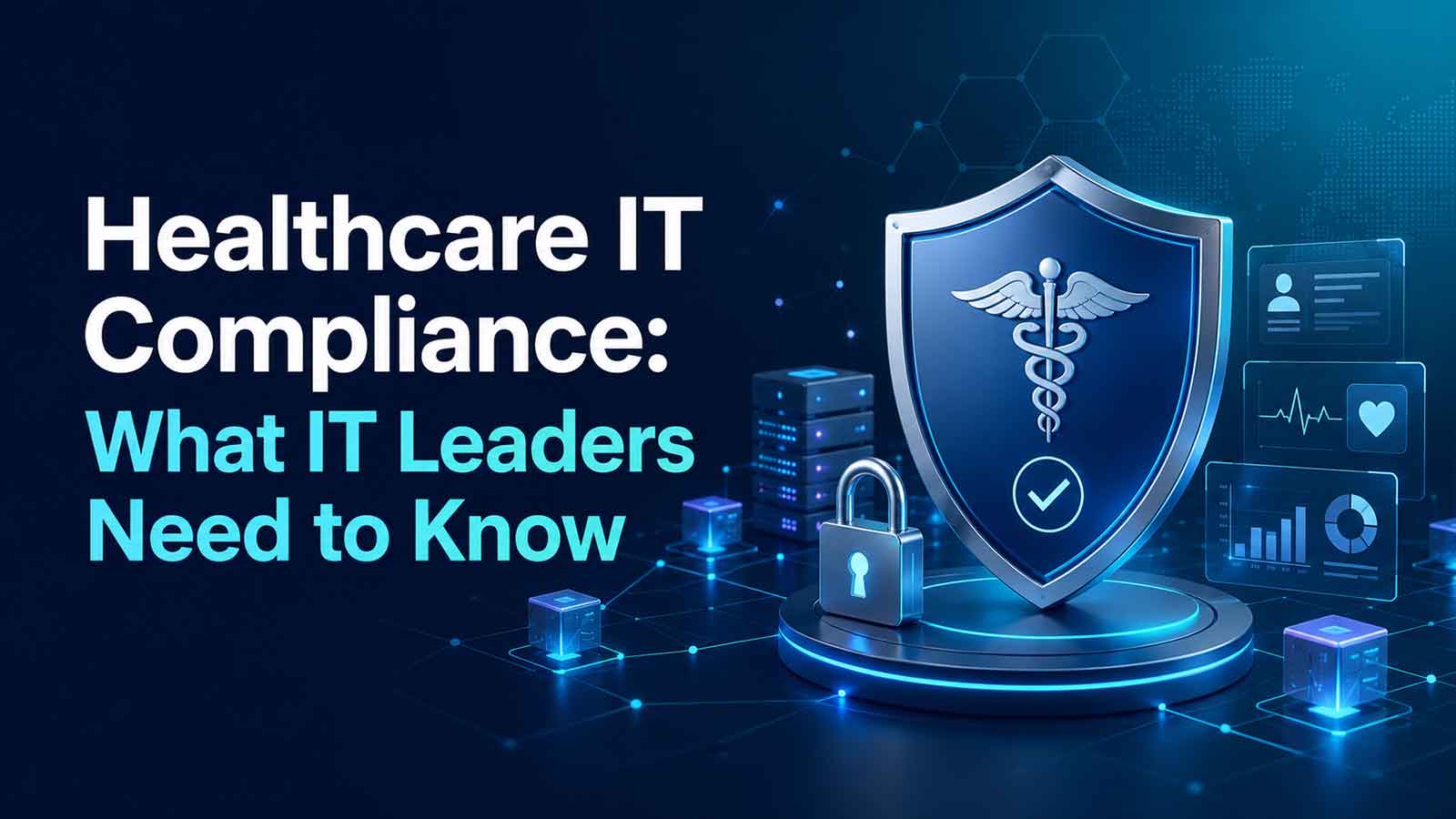
Healthcare IT compliance has become significantly more challenging over the last few years. Cyberattacks are more frequent, healthcare organizations rely on more connected systems than ever before, and regulators continue to tighten expectations around data security, interoperability, and patient privacy. Today, compliance is no longer just about passing an audit or maintaining documentation; it's about keeping critical healthcare services running while protecting sensitive patient information.
The FBI’s 2025 IC3 report says the top reported ransomware variants most impacted Critical Manufacturing, Healthcare and Public Health, and Government Facilities. Proofpoint and Ponemon reported in October 2025 that 72% of U.S. healthcare organizations hit by common cyberattacks saw disruption to patient care. IBM’s 2024 Cost of a Data Breach study put healthcare’s average breach cost at $10.93 million, still the highest of any sector. That is why healthcare IT compliance is no longer a back-office binder exercise. It is directly tied to patient safety, downtime, labor cost, and leadership risk. (ic3.gov)
The compliance target also moved beyond privacy. After the February 2024 Change Healthcare cyberattack, CMS issued flexibilities to keep Medicaid funds flowing and prevent disruption of access to care. HHS later confirmed that Change Healthcare filed its breach report on July 19, 2024, and by October 22, 2024, had sent notices to about 100 million people. In September 2025, ONC and OIG said they would intensify information blocking enforcement, with OIG penalties of up to $1 million per violation for certain actors. For CIOs, CISOs, IT directors, compliance officers, and practice administrators, that means protection of PHI and ePHI now lives in the same operating lane as EHR interoperability, Cures Act information blocking, CMS programs, and vendor oversight. (hhs.gov)
For healthcare IT leaders, this changes the role of compliance. It is no longer a back-office responsibility owned by a single department. It has become a core operational function that directly affects cybersecurity, patient care, business continuity, and regulatory risk.
Healthcare IT Compliance Explained
Healthcare IT compliance is the day-to-day work of keeping systems, people, vendors, and evidence aligned with the rules that govern patient data, security, billing integrity, and information sharing. Real healthcare IT compliance means you can show who had access, why they had it, what changed, what was reviewed, how risk was assessed, and how the organization responded when something went wrong. Paper compliance is a policy that says “we use role-based access.” Operational compliance is an access matrix, provisioning workflow, audit log, review cadence, and ticket history that survive an OCR investigation or payer audit. OCR’s own recent settlements keep coming back to the same basics: risk analysis, risk management, audit controls, authentication, and timely breach response. (hhs.gov)
Inside provider organizations, this reaches far beyond the security team. Hospitals, health systems, physician groups, dental practices, behavioral health organizations, telehealth providers, revenue cycle teams, and managed service partners all touch PHI or systems that influence care and claims. We keep seeing the same pattern: policies live in one place, vendor files in another place, and proof of remediation in inboxes or tickets no one can assemble quickly. That fragmentation is also where fraud, waste, and abuse exposure creeps in. Weak identity controls or poor audit trails can let someone alter scheduling, coding support, or record access without a clean line of accountability. GAO reported in 2026 that CMS estimated it prevented $11.9 billion in potentially fraudulent Medicare payments from FY 2022 through FY 2024 through data analytics and related controls. For IT leaders, data quality and access control are now program-integrity controls too. (gao.gov)
Key Healthcare IT Compliance Regulations You Need to Know
The core stack starts with HIPAA and HITECH. The HIPAA Privacy Rule governs how PHI can be used and disclosed and gives patients rights such as access to their records. The HIPAA Security Rule covers the administrative, physical, and technical safeguards for ePHI. The Breach Notification Rule sets the reporting framework after a breach of unsecured PHI. HITECH strengthened enforcement, expanded direct obligations for business associates, and drives the public breach-reporting model most teams know through the OCR portal. In practice, IT owns identity and access management, logging, encryption, backup and restore, secure release workflows, breach response support, and the system evidence that proves those controls are operating. Auditors usually ask for policies, user access evidence, audit logs, risk analyses, training records, and proof that business associates were under contract through BAAs. (hhs.gov)
Then there is the interoperability layer. The 21st Century Cures Act and ONC’s rules target information blocking and standards-based data exchange. HTI-1, effective from March 11, 2024, with key USCDI v3 dates landing on January 1, 2026, also added algorithm transparency requirements for certified health IT. CMS’s 2024 interoperability and prior authorization final rule expanded API obligations for impacted payers and tied Patient Access API metrics reporting to March 31, 2026. OIG’s information blocking framework and ONC’s 2025 enforcement alert make the practical point clear: release-of-information workflows, exception documentation, API uptime and auditability are now compliance issues.
On top of that, OIG and CMS continue to view documentation quality, access discipline, and payment data integrity as part of program integrity. State privacy laws may add separate notice, retention, or consent rules depending on where you operate. If you run connected devices in care environments, FDA guidance adds cybersecurity expectations around device risk management and hospital safeguards. (healthit.gov)
Healthcare IT Compliance Controls: From HIPAA to the Cures Act
A useful crosswalk connects each rule to concrete controls and the evidence an auditor will actually request.
Regulation | Controls IT should map | Audit-ready evidence |
HIPAA Security Rule (hhs.gov) | MFA, unique user IDs, role-based access, encryption, logging, backup testing, incident response, documented risk analysis | Screenshots of MFA enforcement, access matrix, system logs, restore test results, incident runbooks, signed risk analysis |
HITECH and Breach Notification Rule (hhs.gov) | Breach decision workflow, 60-day notification tracking, audit trails, evidence preservation | Notification timeline, decision tree, legal review notes, affected-system logs, draft notices, ticket history |
Cures Act and ONC information blocking rules (healthit.gov) | Release-of-information workflows, API availability, audit logs, downtime procedures, exception documentation | API monitoring reports, request logs, downtime playbooks, exception memos, complaint escalation records |
CMS interoperability requirements (cms.gov) | Patient Access API support, identity proofing, payer-to-payer exchange, prior authorization workflow controls | API conformance results, identity proofing settings, access reports, workflow tickets, metric submissions |
FDA device cybersecurity expectations (fda.gov) | Asset inventory, patching cadence, segmentation, legacy-device compensating controls, vendor due diligence | Device inventory, patch SLA reports, network diagrams, exception register, vendor attestations and service records |
The point is simple. Regulations do not fail because a policy PDF is missing. They fail because the control named in the policy never made it into the workflow. Providence Medical Institute’s 2024 enforcement action is a blunt example: OCR pointed to obsolete systems, insecure remote access, generic admin credentials, missing encryption, and the absence of a BAA with an IT vendor.
What regulators are scrutinizing right now
From 2024 through 2026, the recurring OCR pattern has been consistent. MMG Fusion’s March 5, 2026 settlement focused on missing risk analysis and failure to notify covered entities after a breach. BST’s August 18, 2025 ransomware settlement focused on the absence of an accurate and thorough risk analysis. Syracuse ASC and a neurology practice settlements in 2025 both emphasized audit controls and user authentication. Providence Medical Institute’s 2024 case added unsupported systems, insecure RDP, and weak vendor oversight to the list. OCR’s current HIPAA Audit Program is also aimed squarely at hacking and ransomware by reviewing 50 covered entities and business associates on selected Security Rule provisions most relevant to those threats. (hhs.gov)
Ransomware remains the enforcement bridge between security operations and privacy law. HHS says a ransomware event is generally presumed to be a breach of unsecured ePHI unless the entity can show a low probability of compromise through the required assessment. HHS also tied its proposed HIPAA Security Rule update to more frequent cyberattacks and common deficiencies OCR keeps seeing in investigations. Add Change Healthcare to that picture, and the lesson is hard to miss: downtime planning, immutable backups, strong identity controls, and third-party concentration risk are all part of current compliance risk. HHS’s healthcare cybersecurity performance goals were published to give the sector a practical floor for preparedness and resiliency. (hhs.gov)
A 30-60-90 Day Healthcare IT Compliance Roadmap
Days 1 to 30. Owners: CIO, CISO, compliance officer, privacy officer, and practice administrator. Priority: critical. Effort: medium. Freeze new shadow IT that touches PHI, confirm incident contacts, review BAAs, inventory every system that creates, receives, maintains, or transmits PHI or ePHI, flag your top vendors, verify the last successful backup restore test, and launch a focused healthcare compliance risk assessment. Audit evidence: governance charter, incident contact sheet, signed BAA inventory, current system inventory, vendor criticality list, and restore-test report.
Days 31 to 60. Owners: CISO, IT manager, HR and privacy officer. Priority: high. Effort: medium to high. Remediate the highest-risk access gaps, enforce MFA, tighten joiner-mover-leaver workflows, set patching SLAs, formalize log review, validate downtime and breach procedures, and start role-based workforce training. Audit evidence: MFA policy and screenshots, HR offboarding checklist, patch dashboard, log review records, tabletop calendar and training completion report.
Days 61 to 90. Owners: CIO, compliance officer, legal, IT manager and practice administrator. Priority: high. Effort: medium. Build a healthcare compliance management dashboard, run a tabletop exercise, complete access recertification, document any information blocking exceptions, review connected-device segmentation and assemble an audit binder with policies, logs, tickets and approvals. Audit evidence: leadership dashboard, tabletop after-action report, access review sign-offs, exception memos, network segmentation diagram and audit binder index.
How to Build Audit-Ready Healthcare IT Documentation
The fastest way to lower audit stress is to standardize what “good evidence” looks like. A risk register should at minimum capture asset, data type, threat, vulnerability, likelihood, impact, owner, due date, treatment decision, and residual risk. A business associate review should cover BAA status, service scope, PHI types, subcontractor use, breach reporting window, MFA, encryption, logging, backup posture, and proof of recent control review. A system inventory should include business owner, hosting model, data classification, interface map, recovery objective, authentication method, and whether the system feeds claims, patient access, or medical devices. Access reviews should run on a tighter cadence for EHR admin roles than for lower-risk systems. A breach decision tree should document the event, data elements, containment, forensic findings, four-factor risk assessment, and notification deadlines. A one-page board dashboard should show open high risks, overdue remediation, vendor reviews due, backup test status, training completion, and incident trends. OCR’s own recent enforcement themes line up with exactly this kind of evidence.
This is also where healthcare compliance analytics becomes useful instead of theoretical. When you connect ticket trends, training completion, access reviews, vendor renewals, and incident logs, you can spot repeat failures before they become findings. We build that operating rhythm inside TeamSync with a governed intelligent repository, no-code workflow automation, and tamper-evident compliance reporting and audit trail. It is a better fit than scattered folders when the real job is proving who approved what and when. For program integrity teams, analytics matter on the payment side too. GAO reported in 2026 that CMS estimated $11.9 billion in potentially fraudulent Medicare payments were prevented from FY 2022 through FY 2024 through data analytics and related controls. (gao.gov)
Common Healthcare IT Compliance Challenges and Edge Cases
Telehealth platforms, remote staff phones, cloud EHR ecosystems, and generative AI tools all change the compliance shape of the work even when the underlying rules are familiar. If a telehealth or AI vendor creates, receives, maintains, or transmits PHI, the BAA and the data-flow map matter immediately. HHS cloud guidance is clear that shared environments need written responsibility splits for authentication, encryption, and incident handling. It also warns that offshore hosting can raise additional risk considerations that belong in the Security Rule risk analysis. For remote work and BYOD, the practical controls are MDM, conditional access, restricted local storage, and tighter minimum-necessary design for mobile views. For AI note drafting or patient messaging, the first questions are where prompts and responses are retained, whether data is used for model training, whether prompt injection risk has been addressed, and whether adding the tool triggered a new risk review. ONC’s HTI-1 rule also brought algorithm transparency further into mainstream certified health IT expectations.
Connected medical devices create another category of edge case because downtime is clinical. FDA’s current device cybersecurity guidance emphasizes design, documentation, and lifecycle security while also stating that healthcare delivery organizations should evaluate network security and protect hospital systems. In practice, that means asset inventories, segmentation, patch windows, compensating controls for legacy devices, and clear escalation paths with biomedical engineering and vendors. Behavioral health teams also need to account for the updated 42 CFR Part 2 framework alongside HIPAA. State privacy laws can stack on top of all of this, especially around notice, retention, and consumer-rights workflows, so legal review has to stay in the loop when your footprint crosses states.
Build a Continuous Healthcare IT Compliance Program
Why healthcare compliance matters is not abstract anymore. The teams that stay ahead are the ones that connect regulations, controls, owners, and evidence in one operating rhythm. In practice, that means knowing the rules, completing a healthcare compliance risk assessment, mapping controls to obligations, monitoring continuously, training the workforce, and keeping vendor oversight current. Good healthcare compliance management feels boring in the best way. Work gets assigned, evidence gets captured, and exceptions get documented before they turn into audit findings. When healthcare compliance analytics is part of that loop, leaders can see drift early instead of discovering it during a breach or payer review.
See how TeamSync can organize your compliance work across IT, security, and operations
If your team is juggling policies in one place, audit evidence in another, and vendor follow-up in inboxes, get in touch to see how TeamSync helps us turn healthcare IT compliance into a shared operating system with clear owners, deadlines, and proof ready when auditors ask. We can centralize policies, run vendor review and access review workflows, track remediation owners, maintain a live dashboard for leadership, and give teams templates for incident response, audit prep, and healthcare compliance management inside our healthcare compliance environment and HIPAA + HITECH controls layer.