On this page
- What compliance risk management actually means when you strip out the jargon
- Compliance vs. risk management is a useful distinction, but in practice the work overlaps every day
- A workable governance model starts with clear ownership, not a giant committee
- How to run compliance risk management as an operating cycle instead of a yearly exercise
- Where compliance programs usually break down: handoffs, evidence and version chaos
- The simplest stack for risk compliance management is one shared system for tasks, approvals and proof
- Start with one regulatory process, then build a system your whole company can actually maintain
- See how TeamSync can turn compliance work into a trackable team workflow
Compliance teams are not dealing with a theoretical problem. In PwC’s Global Compliance Survey 2025, 77% of respondents said compliance had already affected growth-related areas to some or great extent, 82% said their companies planned to invest more in at least one compliance technology, and 63% said disaggregated data across the organization made compliance harder. The SEC’s January 2025 recordkeeping case against 12 firms produced more than $63 million in penalties over off-channel communications. Later, the agency said it filed 456 enforcement actions in fiscal year 2025. That is the practical cost of weak controls, weak evidence and weak follow-through.
The collaboration stack is now part of the evidence stack. Microsoft Teams routes chats, files and channels into communication compliance, retention, DLP, eDiscovery and audit logs. Slack lets enterprise admins place legal holds that preserve messages and files regardless of retention settings. On March 3, 2026, Google Workspace wrote that newer AI tools create “new complexities for governance and compliance” for IT and compliance teams. That is why compliance risk management is no longer just a legal function. The proof lives in chats, tasks, approvals, documents, and handoffs across the business.
What compliance risk management actually means when you strip out the jargon
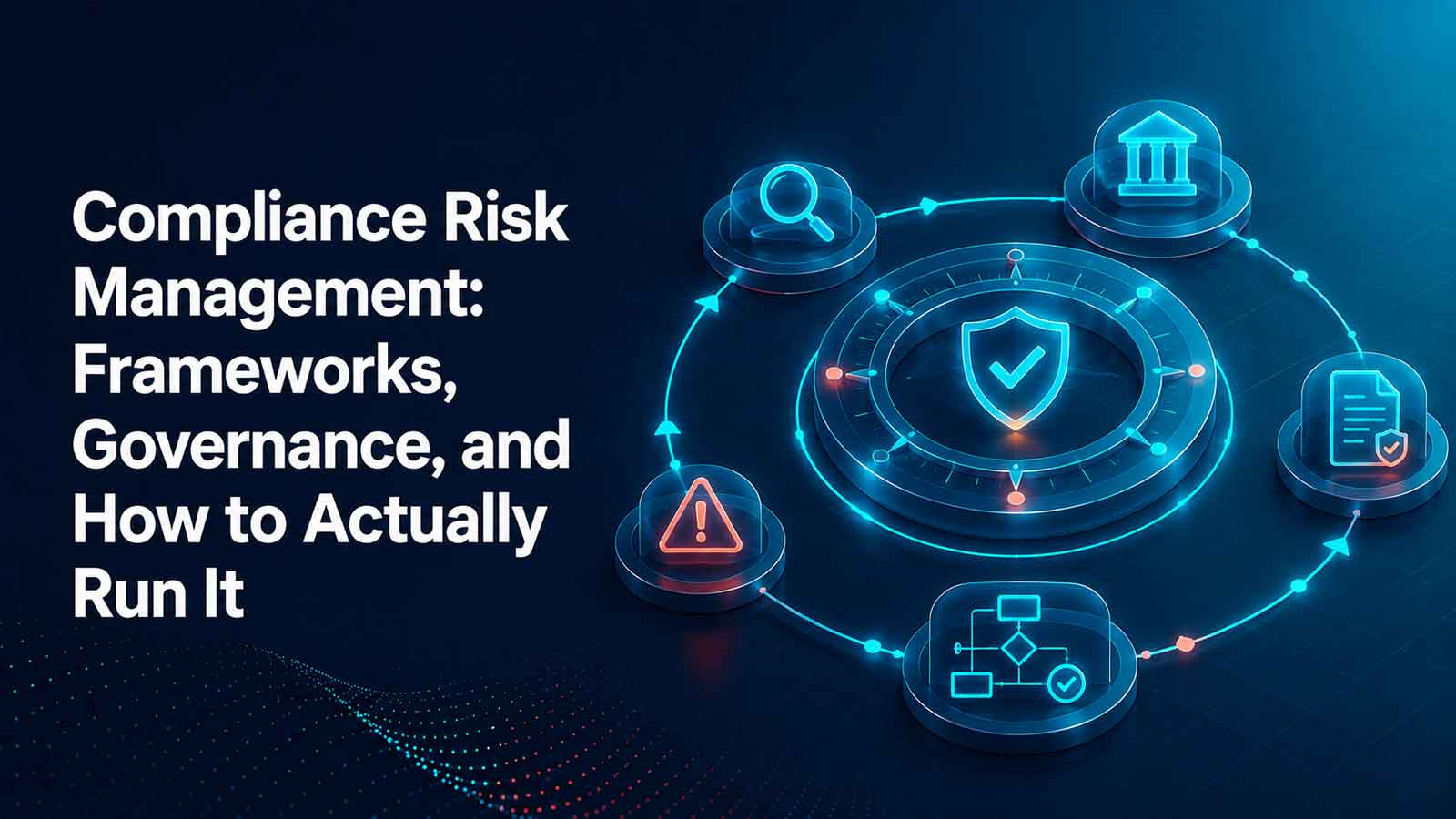
When people ask what compliance risk is and what compliance risk management is, our compliance risk definition is simple: compliance risk is the possibility that a company violates a law, regulation, contract term, or internal policy and pays for it through fines, lawsuits, operational disruption, reputational damage, or lost market access. Compliance risk management is the repetitive work of identifying that exposure, assigning owners, reducing it, and proving the work happened. The easiest way to see risk in compliance is to separate it from broader enterprise risk: a delayed product launch is a business risk, while missed vendor due diligence, weak recordkeeping or an inconsistent approval trail is a regulatory compliance risk because a specific obligation was missed and the evidence is weak. That is why risk and compliance management sit so close together in practice.
Compliance vs. risk management is a useful distinction, but in practice the work overlaps every day
If you are explaining compliance vs risk management to a new leader, start with the center of gravity. Compliance focuses on obligations such as laws, regulations, contracts, standards, and internal policies. Risk management focuses on uncertainty and business impact across financial, operational, cyber and strategic issues. If someone asks what risk and compliance in plain terms is, it is the shared discipline of spotting threats early enough to do something useful about them.
That is why risk management and compliance rarely stay in separate lanes for long. Both identify threats, rate impact, assign owners, monitor controls, escalate exceptions, and keep evidence. The label compliance & risk management exists because the overlap is operational. An access review is a security control, a compliance obligation and a continuity safeguard at once. A third-party diligence gap can start in procurement, turn into legal exposure, and end up as risk management compliance work for compliance, finance, and internal audit.
A workable governance model starts with clear ownership, not a giant committee
For compliance governance and risk management to work, the board or audit committee handles oversight. An executive sponsor, often the GC, CCO, COO or CFO, clears escalation paths and budget. Legal and compliance leadership interpret obligations and own policy decisions. Business risk owners run the controls in their areas. IT and security own access, logging, retention and incident handling. HR handles training, attestations and investigation support. Finance and procurement own payment controls, vendor onboarding and contract obligations. Internal audit stays independent and tests whether the program works.
The artifacts can stay simple: a one-page RACI, a written escalation path, a policy approval workflow, and a review cadence for high-risk issues. We keep seeing the same thing with customers. Once ownership is explicit, meetings get shorter because fewer questions need a room full of people. The goal is faster decisions and cleaner accountability, not more meetings.
How to run compliance risk management as an operating cycle instead of a yearly exercise
When teams ask what compliance risks in daily work are, the answer is usually ordinary operational stuff. Compliance risk examples include privacy notices that were never approved, anti-bribery approvals trapped in email, quarterly access reviews finished without proof, retention requirements applied inconsistently, training completion reports with gaps, and vendor screening done after onboarding. Good regulatory compliance risk management turns those moments into a repeatable operating cycle.
Identify obligations and risks. Build an obligation inventory from laws, contracts, customer commitments and internal policies, then turn it into an initial risk register. Teams usually start here with privacy notices, vendor screening, retention rules or sector-specific recordkeeping duties.
Assess likelihood and impact. Score where failure is most likely and what the business consequence looks like if it happens. The useful output is a prioritized risk register with inherent and residual ratings instead of a flat spreadsheet of equally scary items.
Map and test controls. Link each risk to the control that is supposed to prevent or detect it, such as an approval workflow, an access review, a training requirement, or a retention setting. Teams should come out with a control library, test scripts and an evidence map.
Assign remediation actions. When a control fails, open a dated task with one owner, one due date and a visible dependency chain. The outputs are a remediation plan, a task owner list and an exception log for gaps the business accepts temporarily.
Monitor incidents and regulatory change. Watch complaints, hotline items, audit findings, new rules and internal process changes that alter the control design. This is where anti-bribery approvals, vendor due diligence and access governance often drift first.
Document evidence and reporting. Save approvals, screenshots, test results, training completion records, signed attestations and issue notes in a system that preserves history. Teams need an evidence pack for auditors and a board-ready summary for leadership.
Review and improve. Use incidents, near misses, and audit results to update the risk register, control library, and training plan. A healthy program gets more precise each quarter instead of just getting bigger.
Where compliance programs usually break down: handoffs, evidence and version chaos
We see programs break at the handoffs more than in the policy binder. Legal updates a policy in Word. HR sends last quarter’s PDF. Security tracks exceptions in one system. Procurement stores vendor diligence in a shared drive. Operations signs off in email. Three months later, an auditor asks who approved the exception and whether remediation closed on time. Everyone remembers the meeting. Nobody can produce a clean record.
That is where regulatory compliance risk management becomes an execution problem. Scattered files create duplicate versions. Buried approvals make it hard to show intent. Unclear task ownership slows escalation between legal, HR, security, and operations. By the time an examiner or internal auditor asks for proof, the team is reconstructing history from inboxes and screenshots. The SEC’s off-channel recordkeeping actions are the extreme version of the same lesson: if you cannot preserve and retrieve business communications, you cannot prove the control worked.
The simplest stack for risk compliance management is one shared system for tasks, approvals and proof
For risk compliance management, the simplest stack is one shared system for tasks, approvals and proof. That is as true for IT risk and compliance work like access certification, retention reviews and incident documentation as it is for HR policy attestations or vendor due diligence. The operational need is boring on purpose: centralize policies and evidence, assign owners, track deadlines, document approvals, surface blocked work, and keep a real audit trail.
That is the logic behind TeamSync. Our Intelligent Repository gives us one governed place for records and evidence. Our workflow automation keeps approvals, remediation tasks, and exceptions moving. Our platform is built around one identity model and one audit ledger so teams spend less time chasing status and more time closing gaps. A good compliance governance framework does not require twenty tools. It requires one shared workspace that preserves history well enough for legal, HR, IT, security, and operations to work from the same facts. If your company must keep separate evidence stores by regulator or country, the workflow logic still matters. The handoffs just have to stay visible across those boundaries.
Start with one regulatory process, then build a system your whole company can actually maintain
Start with one contained process that already hurts: vendor due diligence, policy attestations, access reviews, or incident response documentation. Build the owners, approvals, evidence, and review steps around that one flow first. Strong compliance risk management is usually not about writing a bigger manual. It is about creating repeatable workflows with clear ownership and visible evidence that your company can still maintain six months from now. Rules differ by industry and regulator, so let the obligations that actually apply to your business model set the scope.
See how TeamSync can turn compliance work into a trackable team workflow
If your compliance process still lives across inboxes, spreadsheets and scattered docs, see how TeamSync helps us run approvals, track remediation and keep audit-ready records in one shared workspace. Explore TeamSync or get in touch to map one compliance workflow from start to finish.