On this page
- What Does a Healthcare Compliance Officer Do?
- Core Responsibilities and Daily Activities
- Where the Role Sits in the Organization
- The Compliance Officer's Biggest Challenges
- Keeping Up with Regulatory Changes
- Managing Compliance Across Multiple Facilities and Departments
- Building a Culture of Compliance (Not Just Policies)
- Audit Readiness with Limited Resources
- What Healthcare Compliance Officers Need from Technology
- Centralized Policy and Document Management
- Automated Audit Trails and Evidence Collection
- Real-Time Compliance Monitoring and Alerts
- Workflow Automation for Recurring Compliance Tasks
- Healthcare Compliance Analyst: Supporting the Compliance Office
- The Analyst's Role in Data, Reporting and Investigations
- Skills and Tools Analysts Need
- Healthcare Compliance Companies: What to Look for in a Technology Partner
- Industry Experience and Compliance Framework Coverage
- Deployment Options: Why On-Premise Matters for Healthcare
- Integration Capabilities with EHR and Clinical Systems
- Building a Modern Healthcare Compliance Program: A Compliance Officer's Checklist
- The best compliance programs make it easier to respond quickly and prove what happened
- See how TeamSync can help your compliance work move faster without losing the paper trail
Healthcare compliance has become significantly more complex in recent years. Hospitals are facing growing regulatory scrutiny, rising cybersecurity threats, and increasing financial penalties for compliance failures, all while operating under tight budget and staffing pressures.
The news tie-in is not subtle. OCR says its 2024-2025 HIPAA audits are focused on Security Rule provisions most relevant to hacking and ransomware. On April 23, 2026, OCR also announced settlements in four ransomware investigations, bringing the agency to 19 completed ransomware investigations and 13 completed Risk Analysis Initiative matters. HHS’s own guidance says risk management is essential not just for HIPAA compliance but for broader cyber preparedness. That is why secure communication, controlled policy distribution, and audit-ready documentation now sit squarely inside compliance operations. (hhs.gov)
That also changes how we should think about the role. A healthcare compliance officer is not just the policy person. They are the coordinator who keeps legal, clinical, privacy, and operational work aligned when a rule changes, an incident is reported, or a regulator wants to know exactly what happened. (oig.hhs.gov)
What Does a Healthcare Compliance Officer Do?
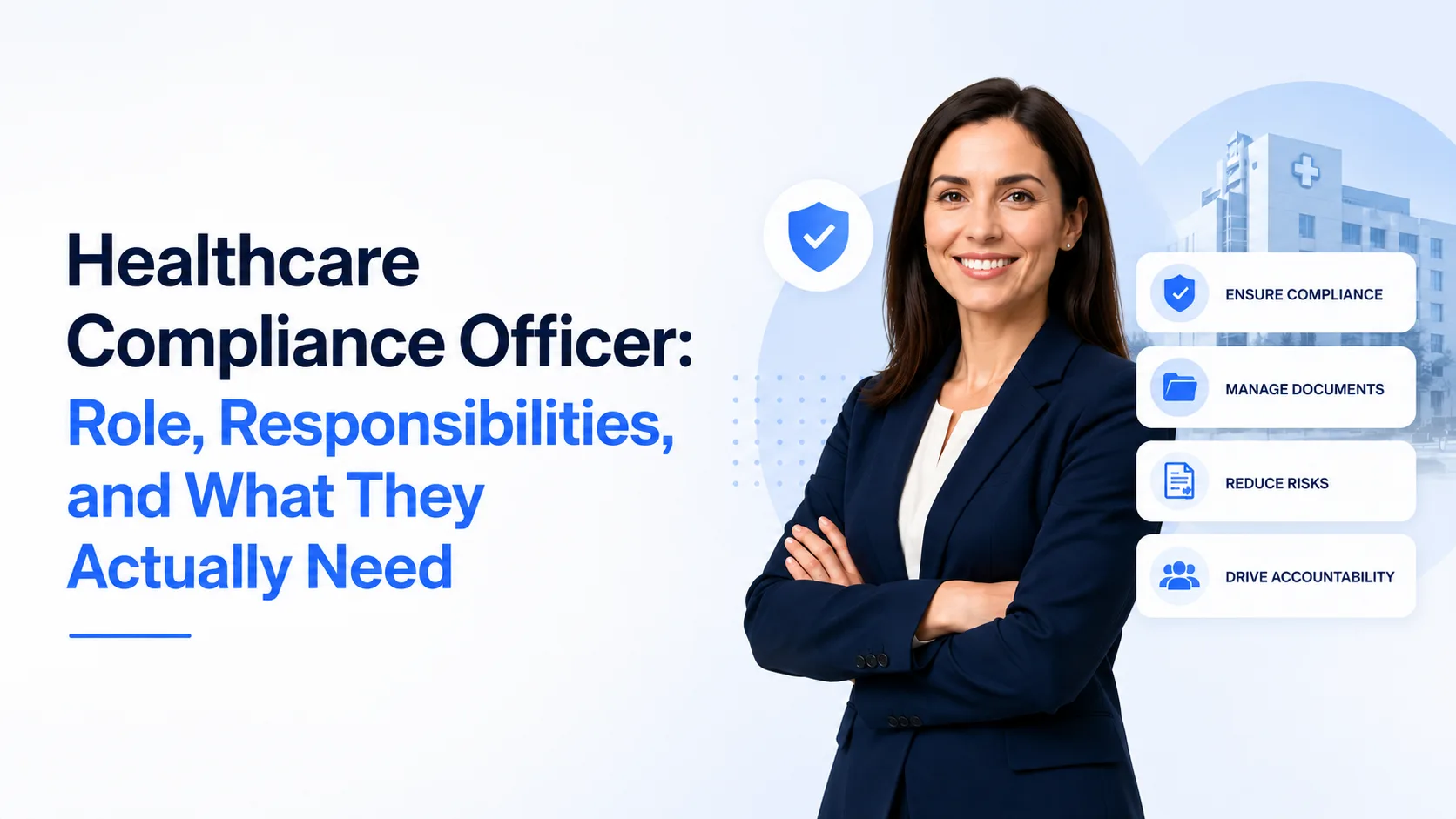
A healthcare compliance officer is the person who turns regulations into day-to-day operating habits. They take HIPAA, billing and coding rules, fraud and abuse restrictions, privacy obligations, contract terms, and internal standards and turn them into workflows staff can actually follow. In plain English, they answer questions like: Which policy applies here? Who needs training? What gets reported? What gets escalated? What proof do we need to keep? (oig.hhs.gov)
The compliance officer healthcare role can sit in a hospital, clinic, payer, physician group, or multi-site health system. The setting changes the risk mix, but the job stays practical. The officer translates legal requirements into approvals, training, investigations, monitoring, and documentation that hold up under pressure. (oig.hhs.gov)
Core Responsibilities and Daily Activities
Policies and standards. The officer builds and updates policies, codes of conduct, and related guidance. That includes version control, review cycles, and making sure staff can find the current document instead of an outdated copy saved in a shared folder. (oig.hhs.gov)
Training and education. They work with department leads to train staff on HIPAA plus billing and documentation rules. The real work is not posting a policy. It is making sure the affected teams understand what changed and what they need to do differently. (oig.hhs.gov)
Auditing and investigations. A healthcare compliance officer runs internal audits and monitoring, reviews hotline complaints and incident reports, and decides when an issue needs a deeper investigation. If a problem is confirmed, they coordinate corrective action plans with owners, deadlines, and documented follow-up.
Screening and third parties. Many teams also track exclusion screening and sanctions, oversee vendor and business associate touchpoints, and make sure outside partners fit the organization’s controls. OIG’s exclusions resources remain a core reference point here because excluded individuals and entities can create direct reimbursement and penalty exposure.
Audit prep and leadership reporting. The officer prepares for external audits and regulator inquiries, reports risk and program status to leadership and the board, and maintains the documentation trail behind decisions. OIG’s current guidance puts special weight on board oversight, reporting cadence, and the compliance officer’s ability to raise issues directly.
A normal week is rarely neat. Monday may start with hotline review. Tuesday can mean meetings with legal and HR. Wednesday is training updates. Thursday is vendor follow-up plus sanctions checks. Friday is leadership briefing and board materials. The work is not only about avoiding fines. It also reduces operational confusion because staff knows which rule applies, which policy is current, and who owns the next step.
Where the Role Sits in the Organization
The role usually sits beside several functions at once rather than cleanly inside one of them. Most officers work closely with legal, privacy, HR, revenue cycle, clinical leadership, IT and internal audit. In larger organizations, they may report to the CEO, a board committee, or the board directly, and OIG says the officer should have enough power, independence, and resources to implement and monitor the program while staying free of duties that would compromise objective oversight. In practice, that means being close enough to operations to spot risk early but independent enough to escalate when a business unit would rather keep moving.
The Compliance Officer's Biggest Challenges
The hard part is not understanding that compliance matters. The hard part is doing more of it across more systems with lean staffing. OIG’s current guidance for large organizations notes that effective compliance functions may need auditors, investigators, clinicians, and data experts plus facility-level resources across multi-location operations. Many teams do not get that ideal setup. They still have to cover the same risk surface anyway. (oig.hhs.gov)
Keeping Up with Regulatory Changes
Rules keep moving across HIPAA, billing and coding, fraud and abuse, CMS requirements, state privacy laws, vendor risk expectations, and internal policy revisions. The bottleneck is rarely reading the update. It is translating the update into approvals, training changes, workflow edits, manager communication, and documented follow-up that proves the change actually landed. That translation work is where compliance hours disappear.
Managing Compliance Across Multiple Facilities and Departments
Risk looks different in inpatient care, outpatient clinics, surgery centers, pharmacy, telehealth, and corporate functions. In a multi-site system, one incident can touch privacy, IT, revenue cycle, operations, and local leadership in the same day. We keep seeing the same friction points: delayed incident reporting, confusion over which policy version is current, fragmented trackers, and evidence buried across email plus shared drives. Once that happens, the real problem is not the incident alone. It is the missing chain of coordination around it.
Building a Culture of Compliance (Not Just Policies)
Policies only work when staff know where to find them, understand what changed, and trust the reporting process. Training has to be followed through by managers. Questions need fast answers. Hotline reports need visible handling so people believe the system works. OIG’s compliance framework still centers on written policies, training, lines of communication, auditing, and corrective action because culture shows up in whether people actually use those channels when something looks wrong.
Audit Readiness with Limited Resources
Audits, investigations, and board reporting do not pause daily incidents. Lean teams feel that strain first. When approvals, evidence, and task ownership live in separate tools, the team spends too much time reconstructing what happened instead of responding to the issue in front of them. OCR has made clear that risk management, evidence, and documentation matter in audits and enforcement. Last-minute document hunts are expensive because they burn time exactly when the organization needs fast answers.
What Healthcare Compliance Officers Need from Technology
The question our customers ask most is not how to add another dashboard. It is how to stop losing context between a policy update, a manager follow-up, and the evidence they need three months later. For a regulated healthcare team, technology works best as operational infrastructure. It should tighten coordination, preserve records, and cut manual handoffs without trying to replace human judgment. (hhs.gov)
Centralized Policy and Document Management
Compliance teams need one place to manage policies, revisions, approvals, attestations, and supporting documents. Without that, staff reference old versions and critical files end up scattered across department folders. A governed repository such as our Intelligent Repository supports the basic thing compliance teams need most: one source of truth that people can actually use. (oig.hhs.gov)
Automated Audit Trails and Evidence Collection
Searchable records matter because they answer the questions regulators and executives ask under pressure: who approved this, when did the policy change, when were staff notified, what happened after the incident, and how was corrective action documented? That is why teams care so much about audit trails. Our Compliance Reporting & Audit Trail fits this need by centering evidence collection around the work itself instead of forcing teams to assemble proof later. (hhs.gov)
Real-Time Compliance Monitoring and Alerts
Useful monitoring is usually boring in the best way. It tells you a review is overdue, an attestation is missing, an action item is unresolved, or an investigation deadline is coming up. It does not flood the team with noise they learn to ignore. Signal matters more than volume when one missed handoff can create a much larger issue. (oig.hhs.gov)
Workflow Automation for Recurring Compliance Tasks
Recurring work is where manual chasing piles up fast. Policy review cycles, training follow-up, investigation steps, reminders, approvals, and repeat documentation requests all benefit from automation because the point is consistency. Our workflow automation capability is built for that kind of repeatable routing and follow-up inside a controlled environment. (oig.hhs.gov)
Healthcare Compliance Analyst: Supporting the Compliance Office
A healthcare compliance analyst usually supports the office by gathering data, tracking trends, preparing reports, and helping the officer see where risk is building. If the officer is setting direction and making judgment calls, the analyst is often the person keeping the evidence organized enough for those calls to be made quickly. (oig.hhs.gov)
The Analyst's Role in Data, Reporting and Investigations
A healthcare compliance analyst often owns reporting, monitoring logs, exclusion screening support, case documentation, trend analysis, and audit preparation. The officer usually sets priorities, interprets requirements with legal input, leads investigations, escalates material risk, and signs off on action plans. That split matters because data support and decision authority are not the same thing even when the two roles work side by side every day. (oig.hhs.gov)
Skills and Tools Analysts Need
Strong analysts are usually great at data organization, documentation discipline, spreadsheets, reporting, case tracking, and clear follow-up with department leads. They also need to be comfortable inside audit workflows where dates, owners, and supporting records matter as much as the narrative itself. Analysts do better when the system makes evidence easy to find and status easy to track instead of forcing them to stitch together screenshots, inbox threads, and folder names. (oig.hhs.gov)
Healthcare Compliance Companies: What to Look for in a Technology Partner
When teams evaluate healthcare compliance companies, they are usually comparing several categories at once: collaboration platforms, policy management tools, hotline and case management systems, training platforms, risk and audit software, and outside advisory firms. The practical lens is simple. Ask where work starts, where evidence ends up, and how many handoffs it takes to move from issue detection to documented resolution. The fewer disconnected steps there are, the stronger the operating model tends to be.
Industry Experience and Compliance Framework Coverage
Healthcare buyers usually want vendors that understand HIPAA, audit documentation, role-based access, cross-department workflows, and the reality of regulated clinical operations. Broad claims matter less than fit. A tool that works well for a general office may still miss the approval history, access controls, or evidence structure a compliance team needs. That is why we design TeamSync with regulated teams in mind, including our healthcare solutions and HIPAA overlay.
Deployment Options: Why On-Premise Matters for Healthcare
On-premise deployment is not the right answer for every organization. Some smaller groups will prefer hosted models because they want less infrastructure to manage. But many healthcare organizations still prefer or require on-premise deployment for security, data governance, integration, or internal IT policy reasons. Others land on private cloud or tightly controlled hosted models. We spend a lot of time in these conversations because deployment is not just a technical choice. It affects ownership, access, and operational trust. Our security and deployment options are built for teams that need that level of control.
Integration Capabilities with EHR and Clinical Systems
Buyers should ask detailed questions about integrations with EHRs, identity systems, document repositories, HR platforms, and clinical or operational systems. The best compliance tools reduce duplicate entry and help teams connect evidence across the systems they already depend on. That is where TeamSync tends to fit best: not as a replacement for every source system but as the collaboration layer that helps people coordinate around them day to day. Our integrations and connectors page is a good place to start if this is on your shortlist.
Building a Modern Healthcare Compliance Program: A Compliance Officer's Checklist
A modern healthcare compliance program should make it easier to manage risk, demonstrate compliance, and stay prepared for audits. Use this checklist to assess whether the key building blocks are in place.
Assign Clear Policy Ownership
Every policy should have a designated owner responsible for updates, approvals, and ensuring it reflects current regulations.
Maintain Up-to-Date Policies
Schedule regular policy reviews with documented approvals and version control, so staff always reference the latest guidance.
Enable Secure Team Communication
Provide secure channels for reporting incidents, asking compliance questions, and sharing sensitive information across departments.Standardize Incident Management
Define clear workflows for reporting, investigating, escalating, and resolving compliance issues with documented follow-up.Keep Audit-Ready Documentation
Store policies, investigation records, approvals, and supporting evidence in one searchable location for quick retrieval during audits.Track Training and Attestations
Monitor mandatory compliance training, completion rates, policy acknowledgements, and overdue requirements across the organization.Strengthen Third-Party Oversight
Regularly review vendors, Business Associates, and exclusion screening processes to reduce regulatory and operational risk.Monitor Compliance Activities
Use dashboards, reminders, and alerts to identify overdue reviews, unresolved action items, and emerging compliance risks.Improve Cross-Department Coordination
Keep legal, privacy, HR, IT, finance, and clinical teams aligned through shared workflows and transparent task ownership.Report Meaningful Compliance Metrics
Provide leadership and the board with concise reports on compliance performance, key risks, corrective actions, and program progress.
The best compliance programs make it easier to respond quickly and prove what happened
The best programs are built for response time and proof. A healthcare compliance officer is a system builder and communicator more than a rule enforcer. When operations are clear, evidence is easy to reach, and staff knows where questions and incidents belong, the organization moves faster under pressure and has a much better answer when someone asks for the record. (oig.hhs.gov)
See how TeamSync can help your compliance work move faster without losing the paper trail
If your compliance work is spread across email, shared drives, and disconnected trackers, see how TeamSync can bring policies, follow-up tasks, audit evidence, and team communication into one place. Get in touch to book a demo to see how we help healthcare teams stay coordinated and audit-ready.